.jpeg)
Solar Power Plant in India: Capacity, Cost & ROI Explained (2026)
With India pushing aggressively towards renewable energy, solar power plants have become a high-ROI asset for homeowners, industries, and landowners. Declining solar installation costs, 25-year power purchase agreements (PPAs), and government incentives have made solar power one of the most stable long-term investments in the energy sector.
Solar Power Plant in India: Capacity, Cost & ROI Explained (2026)
With India pushing aggressively towards renewable energy, solar power plants have become a high-ROI asset for homeowners, industries, and landowners. Declining solar installation costs, 25-year power purchase agreements (PPAs), and government incentives have made solar power one of the most stable long-term investments in the energy sector.
This detailed guide explains what a solar power plant is, how it works, types, capacity sizing, cost structure, government subsidies, and return on investment (ROI)—specifically tailored for India in 2026.
What Is a Solar Power Plant?
A solar power plant is a facility that converts solar radiation—light and heat from the sun—into usable electrical energy. This electricity can power homes, businesses, industries, or be supplied directly to the grid.
Solar power plants are considered one of the cleanest energy sources because:
- They produce zero carbon emissions
- They rely on an unlimited natural resource
- They reduce dependency on fossil fuels
In India, solar plants play a critical role in achieving energy security and sustainability goals under national renewable missions.
How Does a Solar Power Plant Work?
Solar power plants generate electricity using two main technologies:
- Solar Photovoltaic (PV) Technology
- Solar Thermal (Concentrated Solar Power) Technology
Each follows a different method to convert sunlight into electricity.
Types of Solar Power Plants in India
1. Solar Photovoltaic (PV) Power Plant
Solar PV plants directly convert sunlight into electricity using photovoltaic cells made of semiconductor materials such as silicon.
Working principle:
- Sunlight strikes the solar panels
- Photons energize electrons in the solar cells
- Direct Current (DC) electricity is generated
- Inverters convert DC into Alternating Current (AC)
- Transformers adjust voltage for grid supply or consumption
Where used in India:
- Rooftop solar systems
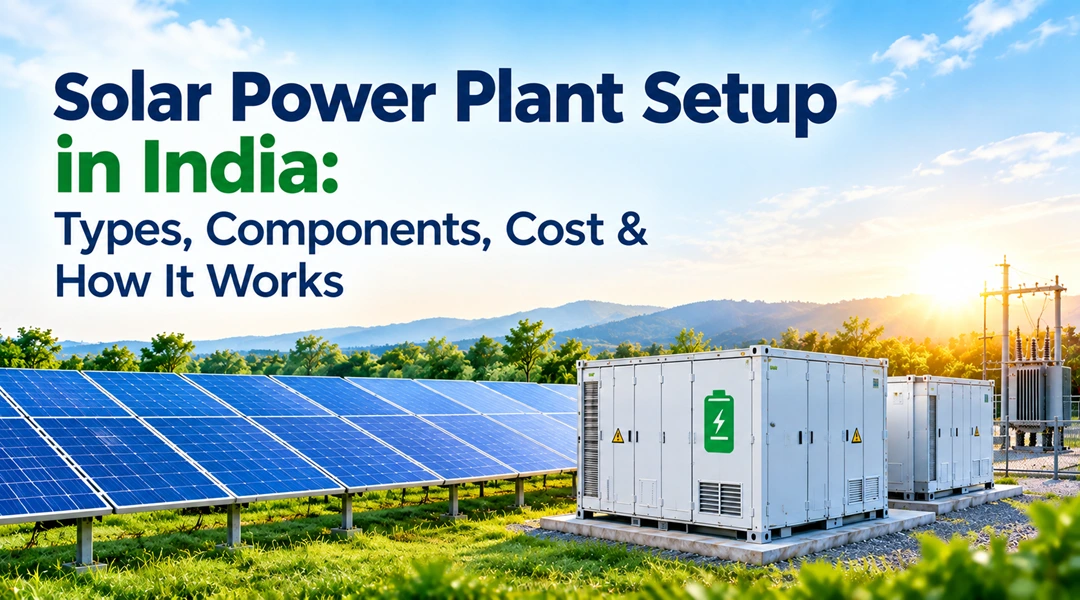
- Ground-mounted solar farms
- Commercial & industrial solar plants
- Utility-scale solar parks
2. Solar Thermal Power Plant
Solar thermal plants generate electricity using heat instead of direct sunlight conversion.
Working principle:
- Mirrors or collectors concentrate sunlight
- Heat raises the temperature of a working fluid
- Steam is produced
- Steam rotates a turbine
- Turbine drives a generator to produce electricity
Types of solar thermal plants:
- Central Tower Systems – Use heliostats (large mirrors) to focus sunlight on a central tower
- Parabolic Trough Collectors – Use curved mirrors to generate high temperatures (250°C+)
Solar thermal plants are less common in India compared to PV due to land and cost constraints.
Classification by Grid Connectivity
On-Grid Solar Power Plant
- Connected to the public electricity grid
- Excess electricity exported via net metering
- Ideal for homes, businesses, and industries with stable grid access
Best for: Lower electricity bills and faster ROI
Off-Grid Solar Power Plant
- Not connected to the grid
- Uses batteries for energy storage
- Suitable for remote and rural locations
Best for: Areas with unreliable or no grid supply
Hybrid Solar Power Plant
- Combines on-grid + battery backup
- Stores power and exports excess to grid
- Ensures power during outages
Best for: Commercial users and locations with frequent power cuts
Ground-Mounted & Commercial Solar Power Plants
Ground-Mounted Solar Power Plant
- Installed on open land
- Large capacity (MW scale)
- Supplies electricity to DISCOMs or under long-term PPAs
Commercial Solar Power Plant
- Installed by businesses or developers
- Generates revenue via energy savings or power sale
- Often used in industrial parks and solar farms
Solar Power Plant Capacity in India (Typical Ranges)
|
Application |
Capacity Range |
|
Street lights |
40W – 100W |
|
Residential homes |
2 kW – 5 kW |
|
Apartments / schools / hospitals |
20 kW – 200 kW |
|
Industrial rooftops |
200 kW – 10 MW |
|
Utility-scale solar plants |
50 MW – 2,000 MW |
Cost of Solar Power Plant in India (2026)
Average Installation Cost (Indicative)
- ₹43 – ₹63 per watt (monocrystalline panels)
- 3 kW system: ₹2 – ₹2.5 lakh
- 5 kW system: ₹2.5 – ₹3.5 lakh
- Commercial & utility plants: Cost reduces significantly per MW due to economies of scale
Costs vary based on location, mounting type, inverter quality, and EPC provider.
Government Subsidy for Solar Power Plants in India
The Government of India offers financial incentives to promote rooftop solar adoption.
Rooftop Solar Subsidy (Residential)
- 25%–30% subsidy via the National Portal for Rooftop Solar
- Applicable only for Made-in-India solar panels
- Subsidy applies mainly to residential installations
Commercial and large ground-mounted plants usually benefit from tax incentives, accelerated depreciation, and PPA-based revenue instead of upfront subsidies.
Return on Investment (ROI) from Solar Power Plants
Residential Solar ROI
- Payback period: 4–5 years
- Lifespan: 25+ years
- Savings: ₹25,000–₹60,000 annually (depending on system size)
Commercial & Industrial ROI
- Payback period: 3–5 years
- ROI improves with net metering and high electricity tariffs
- Long-term savings run into crores for large systems
Utility-Scale Solar ROI
- Revenue via long-term PPAs (20–25 years)
- Stable and predictable cash flows
- Attractive for investors and landowners
Advantages of Solar Power Plants
- One-time investment, long-term gains
- Clean & eco-friendly energy
- Low operating and maintenance cost
- Energy independence
- Reliable power backup
- Scalable from kW to GW levels
Limitations of Solar Power Plants
- High initial capital cost
- Requires shadow-free space
- Power output depends on sunlight availability
- Regular cleaning and maintenance required
Conclusion
Solar power plants are no longer a future concept—they are a present-day necessity for India’s energy ecosystem. Whether for homes, businesses, industries, or large-scale developers, solar offers unmatched benefits in cost savings, sustainability, and long-term ROI.
With falling panel prices, supportive government policies, and increasing electricity tariffs, 2026 is one of the best times to invest in solar power plants in India—for both environmental impact and financial returns.
FAQs
Q: What is a solar power plant?
A solar power plant generates electricity by converting sunlight into electrical energy using photovoltaic panels or solar thermal systems.
Q: Is solar power profitable in India?
Yes. With subsidies, net metering, and rising grid tariffs, solar power offers strong ROI across residential, commercial, and utility-scale projects.
Q: How much maintenance does a solar plant need?
Minimal. Regular panel cleaning and periodic inverter checks are usually sufficient.
Q: Can commercial solar plants be used for homes?
Yes, if sufficient space is available, but residential-specific systems are usually more cost-effective.
Q: Where is the best location to install a solar power plant?
Any shadow-free area—rooftops, open land, or ground-mounted spaces with good sunlight exposure.