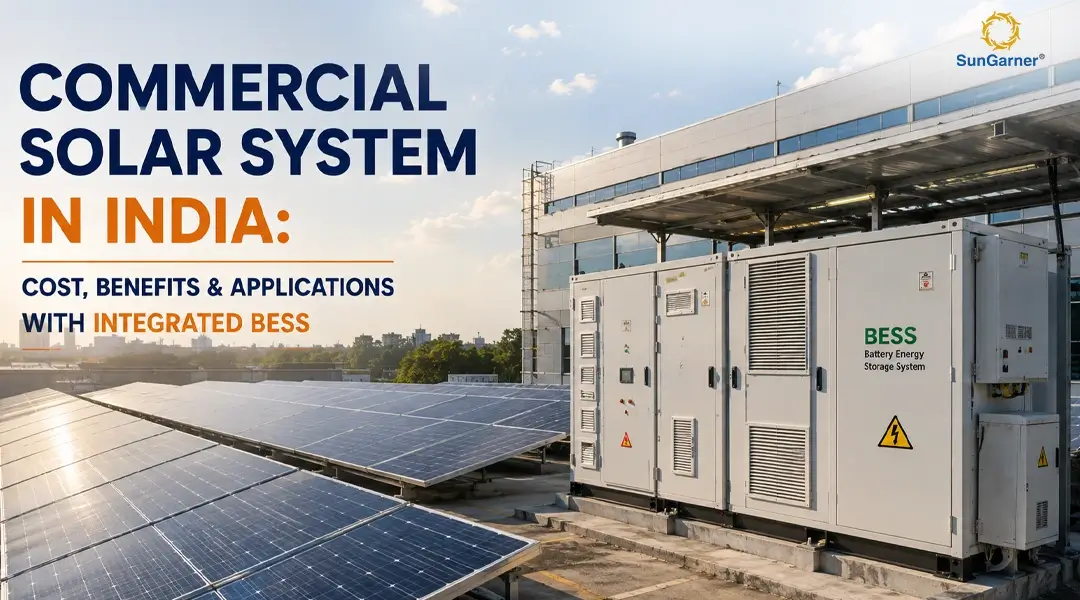
Commercial Solar System in India: Cost, Benefits & Applications with Integrated BESS
For Indian businesses, electricity is not simply a utility expense—it is a recurring operating cost that directly affects profitability.
Offices, factories, warehouses, hospitals, hotels, shopping complexes, educational institutions, retail outlets and other commercial facilities often operate during the same daytime hours when solar power is available. This makes commercial solar systems particularly attractive for reducing grid electricity consumption.
But there is a limitation.
A conventional solar PV system generates electricity only when sunlight is available. If a business needs more power in the evening, during peak tariff periods or during a grid outage, solar alone cannot provide the same level of energy flexibility.
This is where Battery Energy Storage Systems (BESS) become important.
A commercial solar system integrated with BESS can generate electricity from solar during the day, store surplus energy and dispatch that stored energy when it is economically or operationally more valuable.
India's Ministry of Power has identified energy storage as an important part of renewable-energy integration and has introduced measures including BESS-related VGF schemes, procurement guidelines and transmission-charge provisions.
A commercial solar system is a solar PV installation designed to meet the electricity requirements of businesses and commercial establishments. Depending on the load, available area and project economics, systems can range from tens of kilowatts to several megawatts.
A solar-plus-BESS solution combines:
Solar PV + Inverter/PCS + Battery + BMS + EMS + Grid + Loads
The solar system reduces daytime grid consumption, while BESS can store excess solar energy and supply power when required.
For businesses with high electricity consumption, peak-period demand, critical loads or a requirement for greater energy resilience, solar integrated with BESS can provide more value than solar alone.
What Is a Commercial Solar System?
A commercial solar system is a photovoltaic power generation system installed for a business, institution or commercial facility.
Unlike small residential rooftop systems, commercial projects are generally designed around the facility's:
- Connected load
- Contract demand
- Monthly electricity consumption
- Daytime load profile
- Roof or land availability
- Electricity tariff
- Grid connection
- Backup-power requirement
- Regulatory and DISCOM conditions
Commercial solar can be installed as:
- Rooftop solar
- Ground-mounted solar
- Carport solar
- Captive solar
- Open-access solar
- Solar + BESS
- Hybrid renewable-energy systems
The right configuration depends on the business's electricity consumption pattern rather than simply choosing the largest possible solar capacity.
How Does a Commercial Solar System Work?
A typical commercial solar PV system follows this energy flow:
Sunlight → Solar PV Modules → DC Power → Inverter → AC Power → Business Loads
When BESS is integrated, the architecture becomes:
Solar PV → Inverter/PCS → AC Bus → Business Loads
with an additional storage pathway:
Solar Surplus → BESS → Stored Energy → Business Loads
The Energy Management System (EMS) determines when energy should be generated, stored, imported from the grid or discharged from the battery.
For example, during the afternoon:
Solar generation > facility demand
The surplus can be directed towards the battery.
Later, when:
Facility demand > solar generation
the BESS can discharge stored electricity, subject to system design and operating strategy.
This creates a more flexible energy system.
Commercial Solar System Cost in India
One of the most searched questions is:
“What is the cost of a commercial solar system in India?”
There is no single fixed price because commercial projects are highly site-specific.
The final project cost depends on:
- Solar module technology
- Module capacity
- Inverter/PCS selection
- Mounting structure
- DC and AC cabling
- Protection equipment
- Transformer requirements
- Monitoring system
- Roof structure
- Installation conditions
- Civil work
- Grid interconnection
- Project location
- BESS capacity, if required
- Battery chemistry
- Battery warranty
- EMS/BMS requirements
- Fire and safety infrastructure
- Operation and maintenance requirements
Current market guides commonly quote commercial systems across a wide range depending on capacity and specification. For example, published 2026 market estimates put a 50 kW commercial system around ₹22–30 lakh and a 100 kW system around ₹40–55 lakh, while larger projects can have substantially different per-kW economics. These figures should be treated as indicative rather than a project quotation.
Indicative Commercial Solar Cost Range
|
Solar Capacity |
Indicative Project Cost* |
Suitable Applications |
|
25 kW |
₹12–16 lakh |
Small commercial facilities |
|
50 kW |
₹22–30 lakh |
Offices, retail, clinics |
|
100 kW |
₹40–55 lakh |
Hotels, warehouses, institutions |
|
200 kW |
₹75 lakh+ |
Large commercial facilities |
|
500 kW |
Project-specific |
Large commercial & industrial sites |
|
1 MW+ |
Project-specific |
Factories, campuses, large C&I users |
*Indicative market ranges only. Actual EPC pricing varies by module, inverter, BOS, site conditions, taxes, evacuation requirements and project specifications. BESS is not included in these solar-only figures.
For a solar-plus-storage project, the BESS should be priced separately based on power capacity (kW/MW), energy capacity (kWh/MWh), usable depth of discharge, battery chemistry, warranty, cycle requirement, PCS and EMS configuration.
How Much Does Commercial Solar with BESS Cost?
A BESS project cannot be accurately priced only on the basis of battery capacity.
For example:
500 kWh BESS and 1 MW / 500 kWh BESS are not equivalent systems.
The first number represents energy capacity, while the second configuration also specifies the power rating.
A commercial BESS quotation should therefore clearly mention:
- MW/kW power rating
- MWh/kWh energy capacity
- Battery chemistry
- Usable capacity
- Round-trip efficiency
- Depth of discharge
- Cycle life
- PCS rating
- BMS
- EMS
- HVAC/thermal management
- Fire detection and suppression
- Container/enclosure configuration
- Warranty
- Degradation assumptions
- O&M requirements
Example
A business requiring:
500 kW discharge power for 2 hours
could require approximately:
500 kW / 1 MWh BESS
before accounting for usable capacity, efficiency, reserve margin and project-specific operating requirements.
This is why BESS should be sized from the load profile and operational objective, rather than simply choosing a battery based on monthly electricity consumption.
Why Integrate BESS with Commercial Solar?
Solar reduces electricity purchased from the grid.
BESS adds time-shifting capability.
That difference is important.
Consider a business with high daytime solar generation but significant evening electricity consumption.
Without storage:
Solar → Daytime Load
With storage:
Solar → Daytime Load + Battery → Evening/Peak Load
This enables businesses to use more of the electricity generated by their own solar system at a later time.
The Ministry of Power's national energy-storage framework identifies applications such as renewable-energy integration, grid stability, reliability and shifting energy availability as important functions of energy storage.
7 Major Benefits of a Commercial Solar System
1. Lower Electricity Costs
Solar allows businesses to generate a portion of their electricity instead of purchasing all energy from the grid.
For facilities with substantial daytime consumption, this can significantly reduce grid electricity purchases.
The actual savings depend on:
Solar Generation × Avoided Electricity Cost
The economics become more attractive where the avoided grid tariff is high and the solar resource is strong.
2. Better Protection Against Rising Energy Costs
A commercial solar plant can produce electricity for many years.
Once the system is operational, the business is less exposed to future increases in grid electricity prices for the portion of demand served by solar.
This provides greater long-term visibility over energy expenditure.
3. Improved Energy Independence
Businesses can reduce their dependence on grid electricity by combining:
Solar + BESS + Grid
The grid remains an important source of power, but the business gains another controllable energy resource.
4. Reduced Carbon Emissions
Solar generation reduces the amount of electricity that needs to be sourced from conventional grid generation.
This can support:
- ESG objectives
- Sustainability reporting
- Carbon-reduction targets
- Green-building initiatives
- Corporate environmental commitments
5. Better Utilisation of Renewable Energy with BESS
One of the biggest limitations of solar is its generation profile.
Solar production generally peaks during daylight hours, while some businesses have substantial electricity requirements later in the day.
BESS can bridge this timing gap.
This is particularly relevant as India's electricity demand increasingly extends into evening periods. Recent reporting has highlighted rapidly increasing night-time electricity demand and the growing importance of storage in balancing renewable generation.
6. Peak-Demand Management
For businesses with demand-based electricity charges, reducing short-duration peaks can be valuable.
A properly designed BESS can discharge during selected high-demand periods.
The objective is not simply:
“Use battery whenever solar stops.”
Instead, an intelligent EMS can determine when battery discharge creates the greatest operational or financial value.
7. Backup and Power Resilience
For facilities where power interruption can affect operations, BESS can be designed to support selected critical loads.
Examples include:
- Data centres
- Hospitals
- Telecom facilities
- Manufacturing processes
- Cold storage
- Warehouses
- Commercial buildings
- Retail facilities
The backup capability depends on the BESS rating, inverter architecture, critical-load capacity and required backup duration.
Commercial Solar Applications in India
Commercial solar is suitable for a wide range of businesses.
Offices and Corporate Buildings
Solar rooftop systems can offset daytime electricity consumption from:
- HVAC
- Lighting
- Computers
- Elevators
- Pumps
- Server rooms
- Common-area equipment
BESS can additionally support selected loads during evening or grid interruptions.
Hotels and Resorts
Hotels often have substantial electricity requirements for:
- Air conditioning
- Lighting
- Refrigeration
- Water heating
- Kitchen equipment
- Pumps
- Elevators
Solar can reduce daytime electricity purchases, while BESS can help manage evening demand.
Hospitals
Hospitals have critical electricity requirements.
Solar can reduce energy costs, while a properly engineered BESS can provide additional resilience for designated critical loads.
For hospitals, however, storage should be designed around reliability and critical-load requirements, not just electricity-bill savings.
Warehouses and Logistics Centres
Large warehouses typically have significant roof areas that can be suitable for rooftop solar.
Potential applications include:
- Lighting
- HVAC
- Material-handling equipment
- Refrigeration
- EV charging
- Office loads
Shopping Malls and Retail Stores
Commercial solar can offset electricity consumed by:
- Lighting
- Air conditioning
- Escalators
- Refrigeration
- Signage
- Common areas
BESS can be considered where peak demand or evening consumption is significant.
Educational Institutions
Schools, colleges and universities can use solar to reduce electricity costs from:
- Classrooms
- Laboratories
- Administrative buildings
- Hostels
- Sports facilities
- Common areas
Large campuses can also consider ground-mounted solar where rooftop space is insufficient.
Manufacturing and Industrial Facilities
Although industrial facilities are technically a separate C&I segment, many commercial-scale solar principles apply.
Factories can combine:
Solar PV + Grid + BESS
to manage daytime consumption, peak demand and selected critical loads.
For large industrial projects, the system should be designed using interval load data rather than only the sanctioned load.
Commercial Solar vs Commercial Solar with BESS
|
Parameter |
Solar Only |
Solar + BESS |
|
Daytime solar savings |
Yes |
Yes |
|
Stores surplus solar |
No |
Yes |
|
Evening solar utilisation |
Limited |
Yes |
|
Peak-demand management |
Limited |
Better potential |
|
Backup capability |
Limited |
Yes, if designed for backup |
|
Energy shifting |
No |
Yes |
|
System complexity |
Lower |
Higher |
|
Initial investment |
Lower |
Higher |
|
Energy-management capability |
Basic |
Advanced |
The right choice depends on the business's objective.
If the main objective is reducing daytime electricity purchases, solar alone may be sufficient.
If the objective includes energy shifting, peak-demand management, resilience or higher solar utilisation, BESS can make the project more valuable.
How to Size a Commercial Solar System
Choosing a solar capacity only from the roof area is not the best approach.
A professional design should analyse:
1. Electricity Consumption
Review at least 12 months of electricity bills.
2. Load Profile
Understand how much electricity is consumed:
- Morning
- Afternoon
- Evening
- Night
3. Contract Demand
Review sanctioned load and contract demand.
4. Available Roof or Land
Assess:
- Shadow-free area
- Roof orientation
- Structural strength
- Accessibility
- Waterproofing
- Maintenance pathways
5. Grid-Connection Rules
The applicable DISCOM and state regulations should be checked before finalising the system.
6. Future Electricity Demand
If the business plans to add:
- EV chargers
- New machinery
- HVAC
- Production lines
- Additional buildings
future demand should be considered.
How to Size BESS for a Commercial Solar Project
BESS sizing should begin with the business objective.
Objective 1: Solar Energy Shifting
Determine:
How much surplus solar energy is available?
Then determine how much of it should be stored.
Objective 2: Peak-Demand Reduction
Identify:
When does the facility experience its highest demand?
The BESS power rating must be sufficient to reduce the targeted peak.
Objective 3: Backup Power
Determine:
Which loads must remain operational during an outage?
Then calculate:
Required BESS Energy = Critical Load × Backup Duration
For example, if critical loads total 300 kW and the desired backup period is 2 hours:
300 kW × 2 hours = 600 kWh
The actual battery requirement will be higher after considering usable capacity, efficiency, reserve and degradation.
Solar + BESS ROI: How Should Businesses Calculate It?
A commercial solar project's ROI should not be calculated simply by dividing system cost by annual solar generation.
A better financial model considers:
Annual Solar Savings
Annual Solar Generation × Avoided Grid Tariff
BESS Value
Potential BESS value can include:
- Energy time shifting
- Peak-demand reduction
- Backup value
- Increased solar self-consumption
- Reduced diesel-generator dependence, where applicable
Simple Payback
Payback Period = Total Project Investment ÷ Annual Net Savings
For example, if:
- Total investment = ₹50 lakh
- Annual net savings = ₹10 lakh
then:
Simple Payback = 5 years
However, a professional feasibility study should also consider degradation, O&M, financing costs, tariff escalation, battery replacement assumptions and residual value.
Government Policies and Incentives for Commercial Solar and BESS
One important point businesses should understand is that residential rooftop subsidy schemes should not automatically be assumed to apply to commercial consumers.
MNRE's Grid Connected Rooftop Solar Programme states that Central Financial Assistance under the relevant component is provided to residential electricity consumers.
Similarly, PM Surya Ghar is primarily a residential rooftop programme. As of March 2026, the government reported more than 26 lakh residential rooftop systems installed under the scheme.
Therefore, commercial and industrial businesses should evaluate their projects based on applicable:
- State electricity regulations
- DISCOM provisions
- Net-metering rules
- Gross-metering provisions
- Open-access regulations
- Captive-power regulations
- Renewable-energy obligations
- Applicable tax treatment
- BESS-specific policies
rather than assuming residential subsidy benefits.
BESS Policy Support
India has also introduced policy support for energy storage.
The Ministry of Power has stated that the government is implementing VGF schemes supporting approximately 43.8 GWh of BESS development and has introduced procurement guidelines for storage capacity and stored energy.
For certain co-located BESS projects, the government has also provided ISTS-related support subject to the applicable commissioning timelines and conditions.
Because policies and state-level regulations can change, businesses should verify the applicable rules at the time of project development.
Tax Benefits and Depreciation for Commercial Solar
Tax treatment can improve the financial attractiveness of a commercial solar investment.
The Income Tax Department's current depreciation-rate documentation includes solar power generating systems within the relevant depreciation table.
However, the actual tax benefit available to a business depends on:
- Ownership structure
- Tax regime
- Asset classification
- Date of commissioning
- Applicable income-tax provisions
- Accounting treatment
Businesses should therefore evaluate depreciation benefits with their tax advisor rather than assuming a fixed tax saving.
On-Grid, Hybrid or Solar + BESS: Which Is Better?
On-Grid Commercial Solar
Best suited for businesses that:
- Have strong daytime electricity consumption
- Want to reduce grid electricity purchases
- Have suitable rooftop/land availability
- Do not require significant battery backup
Main advantage:
Lower initial investment.
Hybrid Solar + BESS
Best suited for businesses that:
- Need energy storage
- Have evening electricity consumption
- Experience peak demand
- Need backup for critical loads
- Want greater control over energy usage
Main advantage:
Greater energy flexibility.
Solar + BESS + Grid
For many commercial facilities, the grid should not be viewed as the competitor to solar and storage.
Instead, the three resources can work together:
Solar = Generate
BESS = Store & Shift
Grid = Supplement
An EMS can coordinate these resources based on operating conditions.
Key Components of a Commercial Solar + BESS System
A complete system may include:
Solar PV Modules
Convert sunlight into DC electricity.
Solar Inverter
Converts DC electricity into AC electricity for facility use or grid interaction.
Battery Energy Storage System
Stores electrical energy for later use.
PCS – Power Conversion System
Controls bidirectional power flow between AC and battery DC systems.
BMS – Battery Management System
Monitors and manages battery parameters such as voltage, temperature and state of charge.
EMS – Energy Management System
Optimises energy flow between solar, battery, grid and loads.
Protection System
Includes electrical protection and switching equipment.
Thermal Management
Maintains battery operating conditions.
Fire Detection and Safety System
Critical for appropriately designed BESS installations.
Monitoring Platform
Provides real-time visibility into:
- Solar generation
- Battery SOC
- Battery power
- Grid consumption
- Load consumption
- System alarms
What Should Businesses Check Before Buying a Commercial Solar System?
Do not select a system only because it has the lowest price per kW.
Evaluate:
Solar System
- Module efficiency
- Module warranty
- Inverter efficiency
- Inverter warranty
- Mounting structure
- BOS quality
- EPC experience
- Monitoring
- O&M support
BESS
- Battery chemistry
- Usable capacity
- Round-trip efficiency
- Cycle life
- Degradation warranty
- PCS efficiency
- BMS architecture
- EMS capability
- Thermal management
- Fire safety
- Warranty conditions
- Response time
- O&M support
Commercial Terms
- Project timeline
- Performance guarantee
- Generation guarantee
- Payment terms
- Warranty
- AMC
- Insurance requirements
- Replacement conditions
Is Commercial Solar Worth It in India in 2026?
For many businesses, the answer can be yes—but the project should be evaluated using actual electricity and load data.
The strongest commercial solar cases generally combine:
High electricity consumption + good solar resource + suitable installation area + favourable avoided energy cost + long operating horizon
BESS becomes increasingly relevant when the business also has:
Evening demand + peak demand + critical loads + surplus solar + need for energy flexibility
India's broader energy-storage policy direction also supports the increasing role of storage in renewable-energy integration. The Ministry of Power has described BESS and other storage technologies as important for integrating renewable generation and supporting grid balancing.
Why the Future of Commercial Solar Is Solar + Storage
The next stage of commercial solar is not simply about installing more panels.
It is about controlling when energy is generated, stored and consumed.
A solar-only system primarily answers:
“How much electricity can I generate from sunlight?”
A solar-plus-BESS system answers a broader question:
“How can I generate, store and use electricity at the time it creates the most value for my business?”
That distinction becomes increasingly important as electricity demand grows and renewable generation becomes a larger part of India's power mix.
The Ministry of Power's energy-storage framework has projected substantial growth in India's storage requirements alongside renewable-energy expansion, underlining the strategic importance of BESS for future power-system flexibility.
Final Takeaway
A commercial solar system can help businesses reduce dependence on grid electricity, lower long-term energy costs and improve sustainability.
But as commercial energy requirements become more dynamic, solar generation alone may not address every energy challenge.
Integrating Battery Energy Storage Systems (BESS) enables businesses to store surplus solar power and strategically use it during periods when electricity has greater operational or financial value.
The ideal solution is therefore not simply the largest solar plant or the biggest battery.
It is the system that is correctly sized around:
Load Profile + Electricity Tariff + Solar Generation + Peak Demand + Critical Loads + Future Expansion
For businesses evaluating commercial solar in India, a detailed site survey, electricity-bill analysis and load-profile study should be completed before selecting the final solar and BESS capacity.
Frequently Asked Questions
What is a commercial solar system?
A commercial solar system is a solar PV installation designed to generate electricity for businesses, offices, hospitals, hotels, warehouses, institutions, retail facilities and other commercial establishments.
What is the cost of a commercial solar system in India?
The cost depends on system capacity, modules, inverter, BOS, installation conditions, grid requirements and other project factors. Published 2026 market estimates indicate that a 50 kW system may cost approximately ₹22–30 lakh and a 100 kW system approximately ₹40–55 lakh, but actual EPC quotations can vary significantly.
Can a commercial solar system include a battery?
Yes. Solar PV can be integrated with BESS to store surplus electricity and discharge it later.
What is commercial BESS?
Commercial BESS is a Battery Energy Storage System designed to store and supply electricity for commercial or industrial applications.
How is BESS different from a normal inverter battery?
A commercial BESS is engineered for larger power and energy requirements and can incorporate PCS, BMS, EMS, thermal management, monitoring and safety systems. It can be designed for applications such as energy shifting, peak management and critical-load backup.
Is PM Surya Ghar subsidy available for commercial solar?
PM Surya Ghar is a residential rooftop programme. MNRE's rooftop programme documentation specifies CFA for residential electricity consumers under the relevant component. Commercial consumers should check the applicable state/DISCOM rules and other available mechanisms instead.
How long does a commercial solar system last?
Solar PV projects are generally designed for long operating lives, commonly around 25 years or more depending on equipment and warranty conditions. Individual components such as inverters may have different service lives and replacement requirements.
How long does a commercial BESS last?
BESS life depends on battery chemistry, operating temperature, depth of discharge, cycling frequency, charging/discharging strategy and warranty conditions. It should be evaluated using the manufacturer's degradation and cycle-life warranty rather than a generic number.
Can BESS reduce peak demand?
Yes. If correctly sized and controlled, BESS can discharge during selected high-demand periods and potentially reduce peak grid demand.
Is solar + BESS better than solar alone?
Not necessarily for every business. Solar alone can be more economical where daytime consumption is high. Solar + BESS becomes more attractive when energy shifting, evening demand, peak management or backup capability provides sufficient additional value.
Looking to reduce your business's electricity costs with solar and storage?
SunGarner can help businesses evaluate commercial solar and BESS solutions based on their energy consumption, site conditions and operational requirements.
Get in touch with SunGarner for a commercial solar + BESS feasibility assessment and project consultation