
Battery Energy Storage Systems (BESS) are essential for the clean energy transition. They store excess renewable energy, improve grid reliability, and optimize energy usage. BESS supports economic growth, reduces carbon emissions, and helps build a more resilient and sustainable energy ecosystem.
Modern Battery Energy Storage Systems (BESS) are essential for storing excess electricity, balancing supply and demand, and supporting the integration of renewable energy sources. By improving grid reliability, enabling energy flexibility, and providing backup power during peak demand or outages, BESS has become a key component in building a more resilient, efficient, and sustainable energy system for the future.
What is BESS?
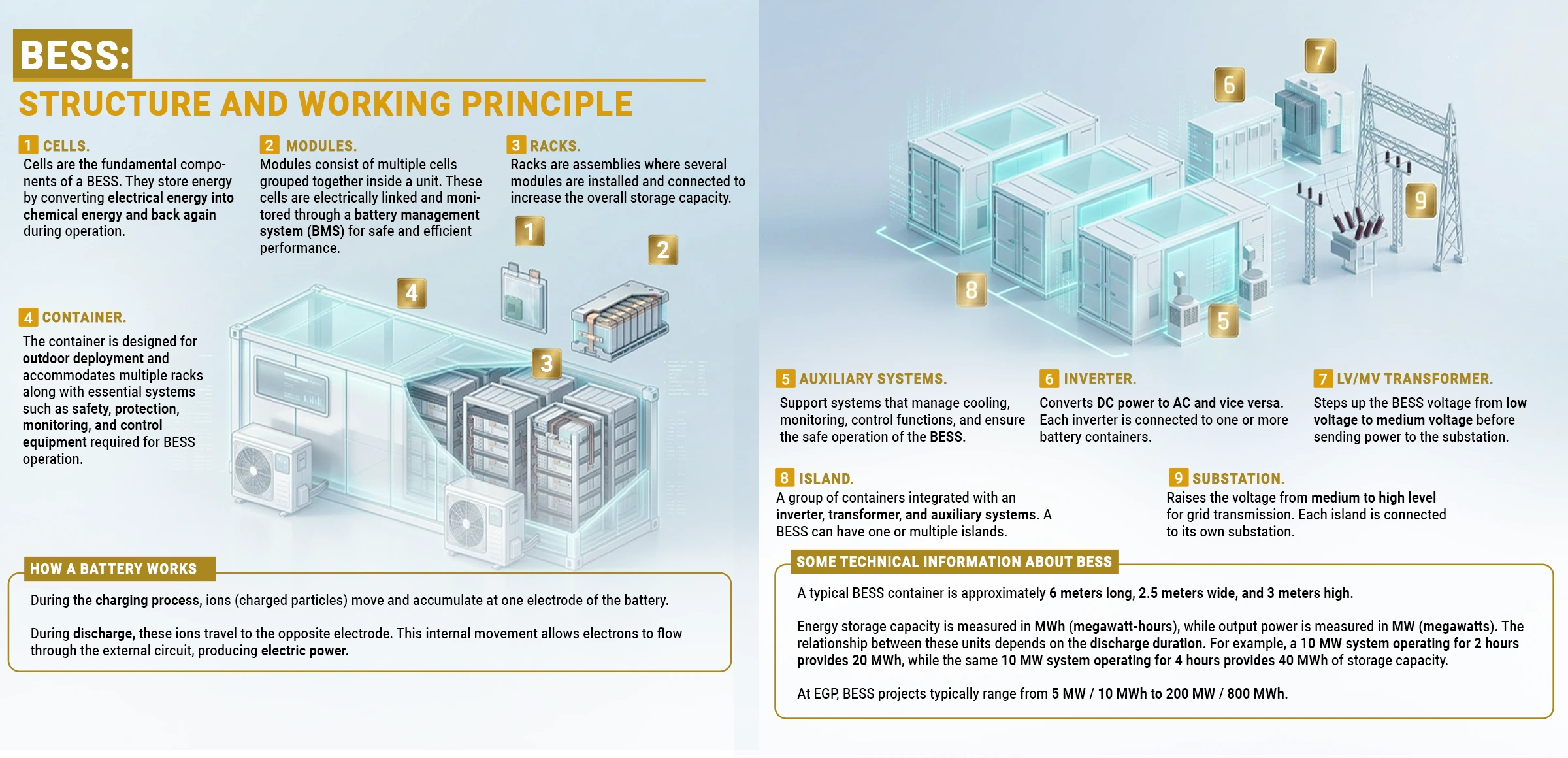
Battery Energy Storage Systems (BESS) store electricity generated from power plants and supply it when needed. These systems typically use multiple batteries grouped together to store and release energy efficiently.
The core component of a BESS is the battery modules; however, several other elements are essential for proper operation. An inverter converts the direct current (DC) stored in the batteries into alternating current (AC) used by the power grid, and vice versa. A transformer adjusts the voltage level to match grid requirements. In addition, auxiliary systems such as cooling and fire protection ensure safe, reliable, and efficient system performance.
How Do Battery Energy Storage Systems (BESS) Work?
Battery Energy Storage Systems (BESS) use electrochemical batteries to store electricity generated from renewable sources such as solar or wind. These systems function much like a large power bank—storing excess energy when production is high and releasing it when energy demand increases.
BESS is one of the most widely used energy storage technologies and is often referred to as an electrochemical energy storage system. This distinguishes it from other storage methods such as gravitational systems (like pumped hydro), mechanical systems (such as compressed air or flywheels), and thermal energy storage systems (TES).
In a BESS setup, electricity generated from a power plant or even a single photovoltaic panel is stored and delivered when needed. The storage process relies on batteries that accumulate electrical charges within chemical materials called electrolytes. During discharge, these stored charges flow between the battery’s poles, releasing electricity for use in the grid or for on-site consumption.
Types of Batteries Used in BESS:
Batteries used in Battery Energy Storage Systems (BESS) are primarily classified based on the chemical elements and materials used in their composition. The most common types include Lithium-ion batteries, known for their high efficiency, long cycle life, and fast response time; Lead-acid batteries, which are widely used due to their reliability and lower cost; Sodium-sulfur (NaS) batteries, suitable for large-scale energy storage with high energy density; and Flow batteries, such as vanadium redox batteries, which are ideal for long-duration energy storage. Each battery type offers unique advantages depending on the application, capacity requirements, and operating conditions of the energy storage system.
Difference Between Domestic and Grid-Level Energy Storage Systems: Energy storage systems are generally classified into two main categories: Behind-the-Meter (BTM) and Front-of-the-Meter (FTM).
Behind-the-Meter (BTM): These systems are installed on the consumer’s side of the electricity meter, typically in homes or commercial facilities. Examples include rooftop solar systems paired with residential batteries. Their primary purpose is to reduce electricity costs, increase energy independence, and store excess power for later use. In some cases, surplus energy can also be exported to the grid, depending on local regulations.
Front-of-the-Meter (FTM): These systems are installed on the utility or grid side and are usually large-scale installations such as battery storage plants connected to solar or wind farms. They are managed by utilities or grid operators to support grid stability, manage power fluctuations, reduce congestion, and optimize energy distribution.
In summary, BTM systems are smaller and designed for end users, while FTM systems are larger and primarily support grid operations.
How Long Does a Battery Storage System Last and How Can It Be Given a Second Life?
A Battery Energy Storage System (BESS) generally lasts 10–15 years, depending on the battery technology, operating conditions, usage cycles, and maintenance. Lithium-ion batteries, which are commonly used in BESS, are designed to handle thousands of charge and discharge cycles while maintaining stable performance.
Even after their primary use, many batteries still retain a large portion of their capacity. Instead of being discarded, they can be reused in second-life applications such as smaller energy storage systems, backup power solutions, or renewable energy integration projects. This reuse extends battery life, reduces environmental impact, and supports a more sustainable and efficient energy ecosystem.
Battery Energy Storage Systems (BESS) play a vital role in supporting economic development and strengthening energy security. By storing excess electricity and supplying it during periods of high demand, BESS improves grid reliability and ensures a stable power supply for industries, businesses, and communities. It also enables greater integration of renewable energy sources such as solar and wind, reducing dependence on fossil fuels and lowering energy costs over time. In addition, BESS helps manage peak demand, prevents power outages, and optimizes energy infrastructure, making the overall energy system more resilient, efficient, and sustainable.
Battery Energy Storage Systems (BESS) are becoming increasingly important in the modern energy landscape, particularly from a social and environmental sustainability perspective. To achieve a fair, reliable, and secure energy transition, the adoption of BESS must continue to expand. Ongoing advancements in technology, along with improvements in cost efficiency and performance, are making energy storage solutions more accessible and practical, reinforcing their growing role in building a cleaner, more resilient energy future.
Delivering Complete Battery Energy Storage Consulting Expertise to Empower IPPs and C&I Clients. At SunGarner Energies Ltd., we deliver specialized Battery Energy Storage System (BESS) consulting solutions designed specifically for Independent Power Producers (IPPs) and Commercial & Industrial (C&I) clients.
With strong in-house R&D capabilities, indigenous technology development, and proven execution experience across diverse projects in India, SunGarner brings practical, implementation-driven expertise to every engagement. Our team works closely with clients to conceptualize, design, optimize, and deploy high-performance energy storage systems that enhance grid reliability, improve energy economics, and maximize project returns.
From feasibility assessment and techno-commercial evaluation to system architecture design, integration strategy, and performance optimization, SunGarner ensures end-to-end advisory support aligned with real-world execution excellence.
1. BESS Feasibility & Financial Structuring
Comprehensive energy profiling, interval load analysis, and demand pattern assessment, coupled with advanced techno-economic analysis. Our advisory covers system sizing, storage duration optimization, and peak shaving analysis, ensuring an optimal dispatch strategy and maximum asset utilization.
2. End-to-End Technical Design & Engineering
We provide optimized BESS sizing and configuration, high-voltage DC system design and engineering.
3. Operational Support & Energy Asset Management
We deliver comprehensive O&M strategy development, including preventive and predictive maintenance planning to ensure maximum system uptime and reliability. Our services include advanced remote monitoring, real-time performance tracking, fault diagnostics, and data-driven battery lifecycle analytics covering degradation analysis, SOH (State of Health), and performance optimization.
Additionally, we provide strategic guidance on battery repurposing, second-life applications, and environmentally responsible recycling in alignment with evolving sustainability and compliance frameworks.
Watch Our BESS System Delivering Reliable Power at Remote Locations
Our Satisfied Clients
some of our great clients and their review
We at Marvel Wires are pleased to say that selecting SunGarner Energies Ltd. as our EPC partner for the installation of a 170kWp rooftop solar power plant was an excellent decision. The quality of workmanship reflects their attention to detail and commitment to excellence. We are satisfied with the plant’s energy generation and the ongoing support provided through their AMC services.

Mr. M S. Negi Founder & CEO, Marvel Wires, India.
We are extremely pleased with the SunGarner Energies solar power plant installation at Geeta Vatika Gorakhpur Cancer Hospital. The project was completed efficiently and has significantly reduced our energy costs. The reliability of the solar power system has been outstanding, ensuring uninterrupted power supply critical for our hospital operations. This initiative not only supports our commitment to sustainability but also provides a greener environment for our patients and staff. We highly recommend SunGarner Energies solar solution to other institutions looking to make a positive impact.

Mr. Umesh Singhaniya Secretary, Geeta Vatika -Poddar Cancer Hospital ,
Gorakhpur.
The SunGarner team did an exceptional job with the installation of our solar power plant at our farm house. Despite the challenges of the remote location, the installation process was smooth and efficient. We are already seeing the benefits in terms of reduced electricity costs and reliable power supply. Thank you, SunGarner, for your outstanding service and dedication!"

Mrs. Anita Thapar Kathpalia,
ATK consultant Former Chief of Marketing Fabindia
SunGarner deploys world-class technology to design, install and commission benchmark solar projects. We avail their services including design, engineering & implementation of solar Off Grid and On Grid Power Plants. It has been more than 5 years now and they are delivering with the latest technology.

Mr. Sunil Sharma Group Vice President, Modi Xerox
SunGarner has a dynamic in-house R&D Department with an experienced back-up, providing customized solutions on problems pertaining to the energy needs of a wide variety of Industrial, Commercial and Residential establishments in several areas. I am happy with their after-sales service too.

Mr. Vinod Ajitsaria Managing Director, V N Dyers & Textiles