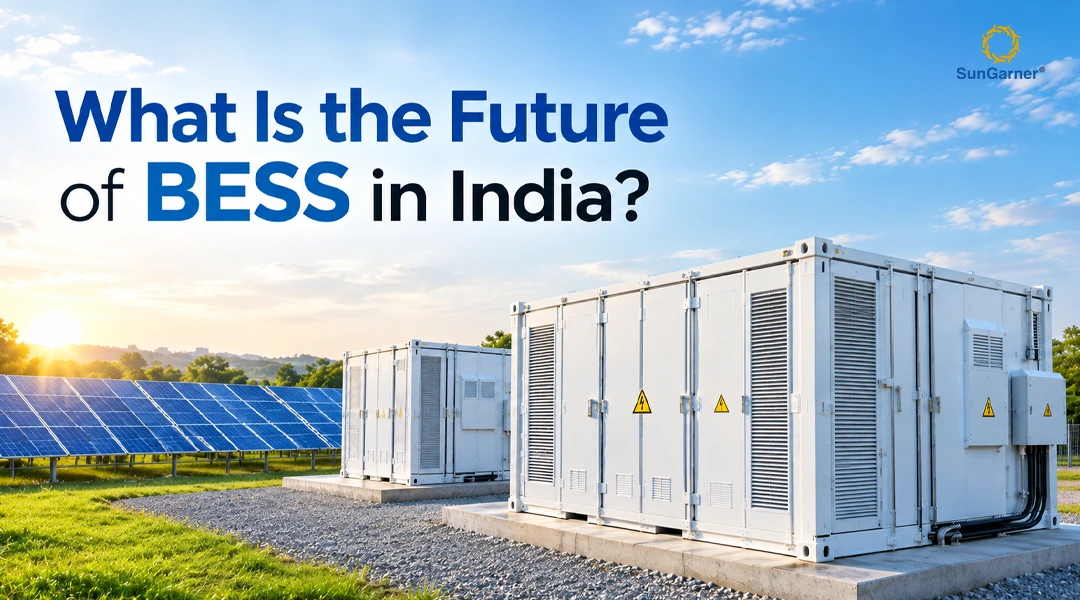
What Is the Future of BESS in India?
India's renewable energy sector is entering a phase where generating clean electricity is only part of the challenge. As solar and wind capacity grows, the power system increasingly needs flexibility to store electricity when generation is high and deliver it when demand rises. This is where Battery Energy Storage Systems (BESS) are becoming increasingly important.
The future of Battery Energy Storage Systems in India is closely connected with renewable energy integration, peak power management, grid stability, commercial and industrial energy requirements, and the country's transition toward a more flexible electricity system.
According to the Ministry of New and Renewable Energy, the National Electricity Plan projects India's total energy storage requirement to rise from 82.37 GWh in 2026–27 to 411.4 GWh in 2031–32. Of this, the projected BESS requirement increases to 236.22 GWh by 2031–32.
This projected growth creates opportunities across utility-scale storage, solar-plus-storage projects, commercial and industrial applications, microgrids, and distributed energy systems.
What Is BESS and Why Is It Important for India?
A Battery Energy Storage System (BESS) stores electricity in batteries and releases it when required. Unlike conventional backup systems that are primarily designed to provide emergency power, modern BESS can perform several grid and energy-management functions.
These include:
- Renewable energy integration
- Peak-load management
- Energy shifting
- Frequency and grid support
- Backup power
- Demand management
- Energy arbitrage
- Microgrid support
- Reduction of renewable energy curtailment
Solar generation is naturally concentrated during daylight hours, while electricity demand can remain high during the evening. BESS can help bridge this timing gap by storing electricity during periods of availability and supplying it later.
The Ministry of New and Renewable Energy identifies energy storage as an important tool for reducing renewable generation variability, supporting grid stability, enabling peak shifting and facilitating greater renewable energy integration.
What Is the Future of BESS in India?
The future of BESS in India is expected to be shaped by five major developments: increasing renewable energy capacity, rising electricity demand, government support, falling technology costs and growing demand for reliable power.
1. Large-Scale Renewable Energy Integration
India is rapidly increasing its solar and wind generation capacity. However, renewable generation is variable.
Solar plants generate electricity during daylight hours, while wind generation can fluctuate depending on weather conditions. This creates a need for flexible resources that can balance electricity supply and demand.
BESS can absorb excess renewable electricity and discharge it when renewable generation is lower.
This makes solar plus BESS particularly relevant for projects where developers need more predictable and dispatchable power.
The Central Electricity Authority has also identified BESS as one of the technologies required to manage the variability and uncertainty associated with large-scale renewable energy integration.
2. Growth of Utility-Scale BESS Projects
Utility-scale storage is likely to become one of the major areas of BESS deployment in India.
Recent tender activity illustrates the scale of projects entering the market. IESA's 2026 tender tracker includes projects such as 1,000 MW/4,000 MWh in Gujarat, 2,000 MW/4,000 MWh in Maharashtra, 625 MW/1,250 MWh in Madhya Pradesh and several other standalone BESS projects.
These projects indicate that energy storage is increasingly being considered as grid infrastructure rather than simply backup equipment.
Over time, utility-scale BESS can support:
- Peak demand management
- Renewable energy firming
- Grid balancing
- Ancillary services
- Transmission and distribution support
- Dispatchable renewable power
3. Expansion of Commercial and Industrial BESS
The opportunity for BESS for commercial and industrial applications is also expanding.
Factories, warehouses, commercial buildings, data centres and other energy-intensive facilities can use BESS to manage electricity consumption and improve power reliability.
A 2026 IESA/CES market study reported that cumulative stationary energy storage installations for India's C&I segment could reach approximately 23–31 GWh by 2032, compared with less than 1 GWh in 2025, depending on the adoption scenario.
Potential applications include:
- Peak-demand reduction
- Backup power
- Renewable energy utilisation
- Solar energy shifting
- Power-quality support
- Energy-cost optimisation
- Critical-load protection
For businesses already using rooftop or ground-mounted solar, adding BESS can create a more flexible energy-management system.
Government Policies Supporting the Future of BESS in India
Government policy is an important factor in the development of the Indian energy storage market.
The Ministry of New and Renewable Energy currently lists several energy-storage-related policies and guidelines, including BESS viability-gap-funding schemes, transmission-charge provisions and guidelines for integrating energy storage into the power sector.
One major initiative is the Viability Gap Funding (VGF) framework for BESS.
The Ministry of Power's 2025 PSDF-supported VGF scheme was designed to support 30 GWh of BESS capacity, with a budget allocation of ₹5,400 crore.
In a March 2026 parliamentary response, the Ministry of Power stated that two VGF schemes were being administered for development of 43.8 GWh of BESS capacity, with storage durations of two or four hours depending on project requirements.
These measures can improve project economics and encourage greater deployment of storage infrastructure.
Energy Storage Obligations Will Drive Demand
Another important development is India's Energy Storage Obligation (ESO) framework.
According to MNRE, the notified ESO trajectory increases gradually from 1% in FY 2023–24 to 4% by FY 2029–30. The framework also requires that at least 85% of the stored energy used for fulfilling the obligation be procured from renewable energy sources annually.
As renewable generation expands, such mechanisms can create additional demand for energy storage capacity.
This means the future BESS market will not depend only on voluntary adoption. Regulatory requirements, grid planning and renewable-energy procurement can also influence deployment.
What Will Drive the BESS Market in India?
Several factors are likely to influence the BESS market in India over the coming years.
Increasing Renewable Capacity
More solar and wind generation means greater demand for flexible storage resources.
Growing Electricity Demand
Industrialisation, urbanisation, electrification and data-centre growth can increase the need for reliable and flexible electricity supply.
Battery Technology Improvements
Higher energy density, improved thermal management, better battery-management systems and longer operating life can improve the economics of BESS projects.
Increasing Need for Grid Flexibility
As the electricity mix becomes more renewable-heavy, the grid will require resources capable of responding quickly to changes in generation and demand.
Domestic Manufacturing
India is also developing its battery manufacturing ecosystem. Greater domestic production can potentially strengthen supply chains and reduce dependence on imported components over time.
Key Applications of BESS in India
The future of Battery Energy Storage System in India is not limited to one market.
Utility-Scale BESS
Large systems can support electricity grids, renewable-energy projects and distribution utilities.
Solar + BESS
Combining solar generation with storage can help shift renewable electricity to periods when it is more valuable or required.
Commercial & Industrial BESS
Businesses can use storage for peak management, backup, energy optimisation and renewable-energy integration.
Microgrids
BESS can support isolated or weak-grid locations by balancing local generation and demand.
Data Centres and Critical Infrastructure
Facilities that require high power availability can use battery storage alongside other backup and power-management systems.
Distributed Energy Systems
Smaller storage systems can increasingly work with rooftop solar and other distributed energy resources.
BESS Market in India: What Businesses Should Consider
Businesses evaluating BESS should look beyond battery capacity alone.
A proper assessment should consider:
- Electricity consumption profile
- Peak demand
- Load characteristics
- Existing solar capacity
- Required backup duration
- Required power rating
- Battery chemistry
- Site conditions
- Safety requirements
- Expected operating cycles
- Tariff structure
- Project economics and payback expectations
For example, a facility requiring short-duration peak management may need a very different system from a site requiring several hours of backup or renewable-energy shifting.
Therefore, BESS sizing should be based on actual energy and power requirements rather than a standard package.
What Does the Future of BESS Mean for Solar Projects?
The relationship between solar and storage is expected to become increasingly important.
Historically, solar projects primarily focused on generating electricity at the lowest possible cost. With higher renewable penetration, the ability to deliver electricity at the right time is becoming increasingly valuable.
BESS can help transform intermittent renewable generation into a more flexible energy resource.
This creates opportunities for:
- Solar + BESS projects
- Firm and dispatchable renewable power
- Hybrid renewable-energy systems
- Commercial solar with storage
- Industrial solar with storage
- Grid-scale renewable projects
The CEA's planning documents and current government policies reflect the increasing importance of storage in integrating renewable electricity into the power system.
The Long-Term Outlook for BESS in India
The scale of India's projected storage requirement shows why BESS is becoming an important component of the country's future electricity infrastructure.
MNRE, citing CEA projections, states that India's BESS requirement could reach 236.22 GWh by 2031–32 and 1,840 GWh by 2047.
Industry projections also point toward substantial expansion. An IESA/CES industry paper reported that India's overall installed energy-storage capacity could reach 346 GWh by 2033, while the pipeline of BESS projects had reached 92 GWh at the time of the report.
These figures are projections rather than guaranteed outcomes. Actual deployment will depend on technology costs, policy implementation, electricity-market structures, financing, manufacturing capacity and project execution.
Nevertheless, the direction is clear: energy storage is moving from a niche application toward a more integrated role in India's electricity system.
Conclusion
The future of BESS in India is closely tied to the country's renewable-energy expansion and the growing requirement for a flexible, reliable and responsive power system.
Utility-scale projects, solar-plus-storage systems, commercial and industrial applications, microgrids and critical infrastructure can all contribute to BESS adoption.
Government initiatives such as VGF support, Energy Storage Obligations and energy-storage planning are helping create a framework for market development, while growing renewable capacity is increasing the underlying need for storage.
For businesses considering BESS, the key question is not simply how much battery capacity to install. The right solution depends on the site's load profile, renewable generation, required duration, operating strategy, safety requirements and financial objectives.
As India's electricity system evolves, BESS is positioned to become an increasingly important part of how power is generated, stored and delivered.
Frequently Asked Questions
What is the future of BESS in India?
The future of BESS in India is expected to include significant growth in utility-scale storage, solar-plus-storage projects, commercial and industrial systems, grid-support applications and renewable-energy integration.
How much BESS capacity will India need?
CEA projections cited by MNRE indicate a BESS requirement of 236.22 GWh by 2031–32 and 1,840 GWh by 2047.
Why is BESS important for renewable energy?
BESS can store electricity when renewable generation is available and release it when required. This helps address the timing mismatch between renewable generation and electricity demand.
Will BESS be useful for industries?
Yes. Commercial and industrial facilities can use BESS for applications such as peak-demand management, backup, renewable-energy utilisation and energy optimisation. Industry projections indicate substantial growth in C&I stationary storage through 2032.
What is solar plus BESS?
Solar plus BESS combines a solar power plant with battery storage. Electricity generated by the solar system can be stored in the battery and discharged later according to the project's operational requirements.
What are the main challenges for BESS in India?
Key challenges include upfront investment, battery degradation, safety, financing, technology selection, project economics and end-of-life battery management.
Is BESS suitable for every solar project?
Not necessarily. The suitability of BESS depends on the project's load profile, electricity tariff, renewable generation pattern, required backup or discharge duration and financial objectives. A technical and economic assessment should be completed before selecting the system.