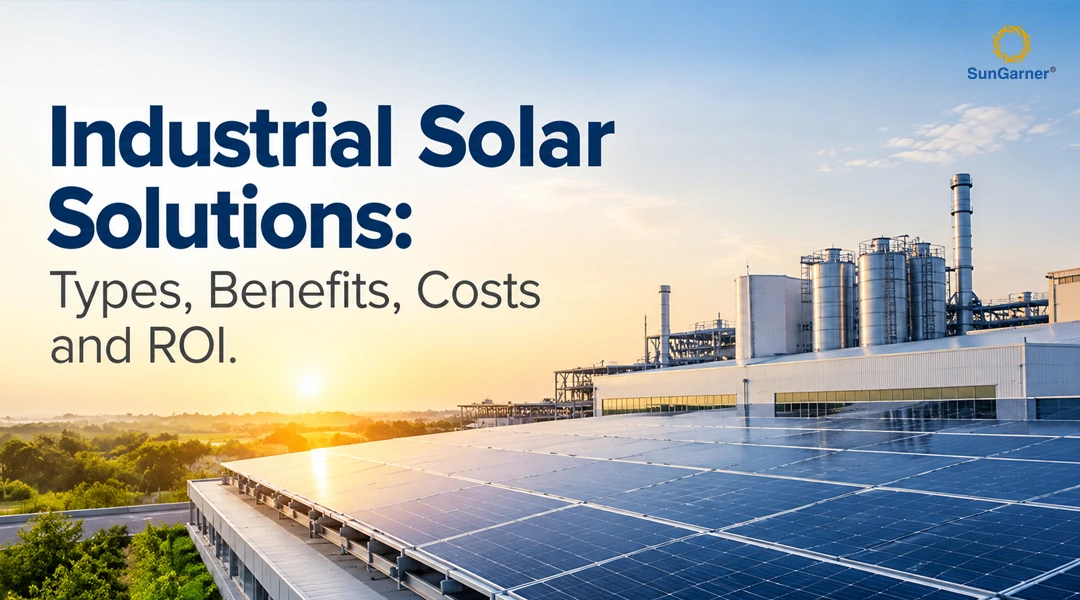
Industrial Solar Solutions: Types, Benefits, Costs and ROI
Electricity is one of the largest and least predictable line items on a factory's balance sheet. For energy-intensive plants, a few rupees of tariff increase per unit can erase an entire quarter's efficiency gains. That is why more manufacturers, cold storage operators, textile units and warehouses are turning to industrial solar solutions to take control of their power costs.
Electricity is one of the largest and least predictable line items on a factory's balance sheet. For energy-intensive plants, a few rupees of tariff increase per unit can erase an entire quarter's efficiency gains. That is why more manufacturers, cold storage operators, textile units and warehouses are turning to industrial solar solutions to take control of their power costs.
This guide explains how an industrial solar system works, the main types available, the benefits beyond lower bills, realistic industrial solar cost ranges, and how to calculate ROI before you commit. By the end, you will know which model fits your facility and what to ask a solar partner.
What Are Industrial Solar Solutions?
Industrial solar solutions are large-scale photovoltaic (PV) systems designed to power factories, processing plants, warehouses and other commercial and industrial (C&I) facilities. Unlike home systems of 3 to 10 kW, an industrial solar system typically ranges from 100 kW to several megawatts and is engineered around heavy, continuous and often three-phase loads.
A typical system includes:
- Solar modules that convert sunlight into DC power.
- Inverters that convert DC into grid-quality AC, usually string or central inverters at this scale.
- Mounting structures designed for metal sheet roofs, concrete roofs, carports or ground installations.
- Monitoring and SCADA systems that track generation, faults and performance in real time.
- Balance of system items such as cables, protection gear, earthing, lightning arrestors and transformers.
Because industrial loads run during daylight hours, solar generation and consumption line up well. That alignment is the reason industrial solar often delivers faster returns than residential projects.
Types of Industrial Solar Systems
Choosing the right configuration is the single biggest design decision. Here are the main options.
1. Rooftop Solar for Factories (Grid-Connected)
The most common choice. Panels are installed on factory roofs, sheds or warehouse tops, and the system feeds your internal load first, with the grid covering any shortfall. Excess power can be exported under net metering where state policy allows.
Best for: Facilities with 10,000+ sq ft of usable, shadow-free roof space and daytime loads. Advantages: No extra land, lowest installation complexity, quick deployment (often 2 to 4 months).
2. Ground-Mounted Industrial Solar
When roof space is limited, structurally weak or shaded, panels are mounted on open land inside or adjacent to the plant. Ground systems allow optimal tilt and orientation and easier cleaning.
Best for: Plants with spare land and higher power needs. Trade-off: Needs land and slightly higher civil costs, but often yields more energy per kW installed.
3. Solar Carports and Canopies
Panels mounted above parking areas, loading bays or walkways generate power while providing shade. They are ideal for sites with large paved areas and little roof capacity.
4. Open Access and Captive Solar
In open access, a solar plant is built at a different location and the power is wheeled to your facility through the grid. In captive models, the consumer holds a stake in the generating plant. This route suits large consumers, often 1 MW and above, who want to offset a major share of their consumption.
Watch for: Wheeling charges, banking rules, cross-subsidy and additional surcharges, which vary by state.
5. Hybrid Solar with Battery Storage
A Battery Energy Storage System (BESS) pairs lithium-ion batteries with a power conversion system and an energy management system (EMS). Added to an industrial solar system, it lets a plant store surplus daytime energy and use it for evening shifts, peak-demand shaving or backup during outages. Costs are higher, but the model is gaining ground where grid reliability is poor or time-of-day tariffs are steep.
6. Off-Grid Industrial Solar
For remote sites such as mines, agri-processing units and telecom facilities with no reliable grid, off-grid systems with batteries and often a diesel generator backup provide stable power.
Quick Comparison
|
System type |
Typical size |
Space needed |
Upfront cost |
Best use case |
|
Rooftop (grid-tied) |
100 kW to 5 MW |
Roof area |
Low to medium |
Daytime-heavy factories |
|
Ground-mounted |
500 kW to 10+ MW |
Open land |
Medium |
Large loads, spare land |
|
Carport |
50 kW to 2 MW |
Parking areas |
Medium to high |
Limited roof space |
|
Open access / captive |
1 MW+ |
Off-site |
Varies (often OPEX model) |
Very large consumers |
|
Hybrid with storage |
100 kW+ |
Roof or land plus battery room |
High |
Peak shaving, backup |
|
Off-grid |
Varies |
Land plus batteries |
High |
Remote locations |
Key Benefits of Industrial Solar Solutions
Lower and More Predictable Electricity Costs
Solar power is generated at a fixed cost over 25 years, often well below prevailing industrial tariffs. While grid rates tend to rise over time, your solar cost per unit stays essentially flat, giving you budget certainty.
Strong Financial Returns
Most well-designed projects pay back in a few years and then deliver free or near-free power for two decades more. Lower energy cost also improves product margins and competitiveness.
Tax and Policy Advantages
In India, businesses can usually claim accelerated depreciation on solar assets, which reduces taxable income in the early years. Some states offer capital subsidies, electricity duty exemptions or favorable net metering terms. Policies change frequently, so confirm current rules with your solar partner and tax advisor.
Reduced Carbon Footprint and ESG Credibility
Buyers, exporters and investors increasingly ask for emissions data. Solar helps cut Scope 2 emissions, supports sustainability reporting, and can help you meet requirements from global supply chain customers, including carbon border adjustment mechanisms in export markets.
Protection from Tariff Hikes and Outages
Generating your own power shields you from fuel cost adjustments and tariff revisions. Paired with storage, it also reduces dependence on diesel generators.
Low Maintenance and Long Asset Life
Solar has no moving parts in the generation process. Routine panel cleaning, periodic inspections and inverter servicing are typically enough. Quality modules carry 25 to 30 year performance warranties.
Better Use of Idle Space
Unused roofs, parking lots and vacant land begin earning value as energy assets.
Industrial Solar Cost: What Should You Expect?
Industrial solar cost depends on system size, type, location and component quality. As a broad planning guide for rooftop C&I projects in India, installed costs commonly fall in the range of roughly ₹35,000 to ₹55,000 per kW, with larger systems at the lower end of that range because of economies of scale. These are indicative figures only; get a site-specific quotation for accuracy.
Main Cost Components
- Solar modules: About 40 to 50% of total cost.
- Inverters and electrical equipment: About 10 to 15%.
- Mounting structure: About 10 to 15%.
- Installation, civil and labor: About 10 to 15%.
- Design, approvals, grid connection and monitoring: About 5 to 10%.
Factors That Move the Price
- System size. Cost per kW falls as capacity rises.
- Roof type and condition. Metal sheets, RCC roofs and older structures need different mounting solutions and sometimes reinforcement.
- Module technology. Mono PERC and TOPCon panels cost more but generate more per square foot. Domestic content requirements, such as the ALMM list for certain projects, can also influence pricing.
- Grid connection requirements. Transformer upgrades, cabling distance and utility approvals add cost.
- Storage. Batteries can add a substantial amount to the project budget.
- Location and irradiation. Sunnier regions produce more units per kW, improving effective cost.
Financing Models
- CAPEX (outright purchase): You own the system, claim depreciation and enjoy the highest long-term savings.
- OPEX / PPA (power purchase agreement): A developer installs and owns the plant; you pay only a per-unit tariff, usually lower than your grid rate. No upfront investment.
- RESCO or lease models: Similar to OPEX, with fixed monthly payments.
- Green loans: Bank or NBFC financing, sometimes at concessional rates for renewable projects.
Industrial Solar ROI: How to Calculate Payback
The two numbers that matter most are the payback period and the internal rate of return (IRR). Here is a simple worked example.
Illustrative Example: 500 kW Rooftop System
|
Parameter |
Assumption |
|
System size |
500 kW |
|
Installed cost |
₹45,000 per kW, so ₹2.25 crore |
|
Annual generation |
About 1,450 units per kW, so 7.25 lakh units |
|
Grid tariff offset |
₹8 per unit |
|
Year 1 savings |
About ₹58 lakh |
|
Annual O&M |
About ₹4 lakh |
|
Net year 1 benefit |
About ₹54 lakh |
|
Simple payback |
Around 4.2 years |
With accelerated depreciation and rising grid tariffs, effective payback can shorten further. Over a 25-year life, the same system can generate savings several times its original cost.
The figures above are illustrative, not a quotation. Actual results depend on your tariff, load profile, location and shading.
What Improves ROI
- High daytime consumption and a high industrial tariff.
- Good solar irradiation and a shadow-free site.
- Quality components with low degradation (around 0.4 to 0.5% annually).
- Proper O&M, including regular cleaning and performance monitoring.
- Right-sizing the system to your actual load rather than the maximum roof area.
What Can Reduce ROI
- Oversizing without export or banking provisions.
- Poor-quality components that fail early.
- Weak monitoring and neglected maintenance.
- Shading from nearby structures or equipment added later.
- Hidden grid charges that were not factored in at the planning stage.
How to Choose the Right Industrial Solar Partner
Your results depend as much on the installer as on the equipment. Evaluate potential partners on these points:
- Proven C&I experience. Ask for completed projects of similar size and sector, with references you can visit.
- In-house engineering. A good solar EPC company conducts load analysis, shadow simulation and structural assessment before quoting.
- Tier-1 components and transparent specifications. Insist on named brands, warranty documents and performance guarantees.
- End-to-end service. Design, procurement, installation, net metering approvals and commissioning should be handled under one accountable team.
- Long-term O&M support. Look for remote monitoring, preventive maintenance contracts and a clear service response time.
- Clear commercials. Compare quotes on cost per kW, expected generation, and 25-year savings, not just the headline price.
Implementation Roadmap
- Energy audit: Review bills, load curves and tariff structure.
- Site survey: Check roof strength, shading, space and grid connection point.
- Design and financial model: Size the system and project savings and payback.
- Approvals: Utility, net metering and any state subsidy applications.
- Procurement and installation: Typically 2 to 6 months depending on size.
- Commissioning and monitoring: Grid synchronization, testing and live performance tracking.
- O&M: Ongoing cleaning, inspection and reporting.
Conclusion: Start Saving with the Right Industrial Solar Solution
Industrial solar solutions are no longer a sustainability gesture; they are a financial strategy. By matching the right system type to your load, choosing a financing model that suits your balance sheet, and working with an experienced installer, you can cut energy costs, hedge against tariff hikes and strengthen your ESG position, all while earning a return that compares favorably with most business investments.
Frequently Asked Questions
What are industrial solar solutions?
Industrial solar solutions are large-capacity solar power systems built for factories, plants, warehouses and other commercial facilities. They include rooftop, ground-mounted, carport, open access, hybrid and off-grid configurations designed to cut electricity costs and emissions.
How much does an industrial solar system cost?
Industrial solar cost for rooftop projects in India generally ranges from about ₹35,000 to ₹55,000 per kW, depending on size, roof type, components and grid requirements. Larger systems usually cost less per kW. A site survey is needed for an accurate quote.
What is the payback period for industrial solar?
Most industrial solar projects pay back in about 3 to 5 years, with tariff levels, daytime consumption, financing model and available tax benefits driving the final figure. After payback, the system continues producing low-cost power for 20 or more years.
How much roof space do I need?
As a rule of thumb, 1 kW of solar needs about 80 to 100 sq ft of shadow-free roof area. A 500 kW system therefore needs roughly 40,000 to 50,000 sq ft.
Can solar power run my entire factory?
Solar alone can cover a large share of daytime demand, but full 24-hour supply requires batteries or grid backup. Most factories use solar to offset 20 to 60% of consumption, depending on available space and load pattern.
What is the difference between CAPEX and OPEX solar models?
In the CAPEX model you buy and own the system, gaining the highest lifetime savings and tax benefits. In the OPEX or PPA model, a developer owns the plant and you pay only for the electricity consumed, with no upfront investment.
How long do industrial solar panels last?
Quality panels are warranted for 25 to 30 years and typically retain about 85 to 90% of their original output at the end of that period. Inverters generally need replacement once during that span, after roughly 10 to 15 years.
How much maintenance does an industrial solar system need?
Maintenance is minimal: periodic panel cleaning, visual and electrical inspections, and monitoring-based fault detection. A structured O&M contract helps keep generation at its best.
Do I need government approvals?
Yes. Grid-connected systems typically need approval from the local distribution utility, and net metering or open access requires additional applications. An experienced EPC partner usually manages this paperwork for you.
Is industrial solar worth it in 2026?
For most facilities with steady daytime loads and reasonable roof or land availability, yes. Falling equipment prices, rising grid tariffs and growing ESG pressure continue to strengthen the business case. A load and site analysis will confirm the numbers for your plant.