BESS Companies in India for Grid-Scale & Renewable Energy Projects (2026)
India’s renewable energy capacity is expanding at an unprecedented pace, driven by utility-scale solar and wind installations across multiple states. However, the variability of renewable generation and rising peak electricity demand have made grid-scale BESS in India a critical requirement rather than an optional add-on.....
Introduction: Why Grid-Scale BESS Matters in India
India’s renewable energy capacity is expanding at an unprecedented pace, driven by utility-scale solar and wind installations across multiple states. However, the variability of renewable generation and rising peak electricity demand have made grid-scale BESS in India a critical requirement rather than an optional add-on. Battery Energy Storage Systems (BESS) enable renewable power to be stored and dispatched when needed, ensuring grid stability, peak load management, and reliable electricity supply.
As solar and wind capacities scale into multi-GW levels, battery energy storage companies in India are playing a pivotal role in supporting round-the-clock renewable energy. From frequency regulation and peak shaving to renewable energy firming, utility-scale battery storage in India is rapidly transitioning from pilot deployments to MW- and GWh-scale projects backed by central and state government tenders.
Supported by Viability Gap Funding (VGF), SECI and DISCOM-led procurement, and hybrid renewable policies, solar plus storage projects in India are attracting EPC contractors, independent power producers (IPPs), utilities, and global technology providers. This has positioned BESS as a core pillar of India’s clean energy and power system resilience strategy through 2030 and beyond.
What Is a Grid-Scale BESS?
A grid-scale Battery Energy Storage System (BESS) refers to large-capacity battery installations—ranging from several MWh to multiple GWh—connected directly to transmission or distribution networks. These systems are designed to support the power grid at scale rather than individual facilities.
Key Functions of Grid-Scale BESS
- Peak load balancing and demand shifting
- Frequency and voltage regulation
- Renewable energy time-shift and firming
- Backup power for critical infrastructure
- Grid congestion management
India’s renewable energy storage systems market is evolving rapidly, with deployment moving from hundreds of MWh to multi-GWh capacities under national and state-level programs.
Top BESS Companies in India (2026)
The following companies are actively shaping the grid-scale and renewable energy storage market in India, based on execution capability, project scale, and relevance to utility-scale deployment.
1. SunGarner Energies Ltd
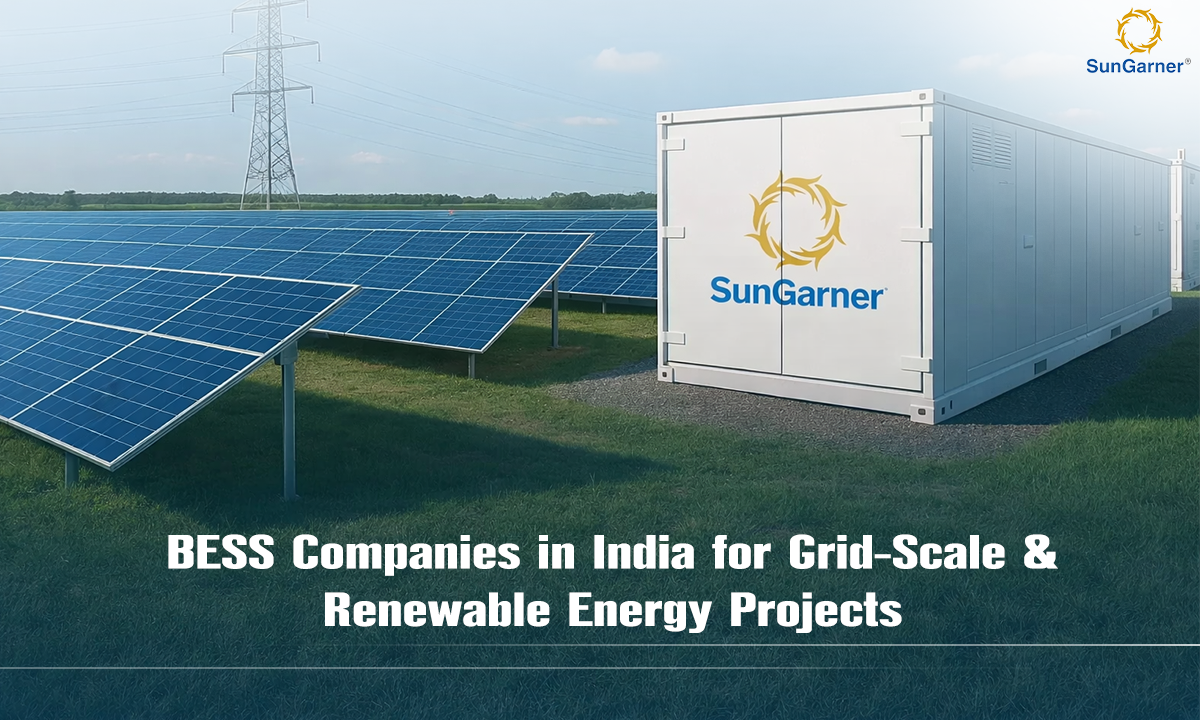
SunGarner Energies Ltd is an emerging BESS-enabled solar EPC company in India, focused on integrating battery energy storage with large-scale solar and renewable power plants. With experience in executing utility-scale solar projects across multiple Indian states, the company is expanding into renewable-plus-storage EPC solutions to deliver firm, dispatchable power.
Why SunGarner Energies Stands Out:
- End-to-end Solar + BESS EPC expertise
- Strong execution capabilities for grid-connected projects
- Focus on utility-scale, C&I, and renewable-plus-storage solutions
- Engineering-driven approach ensuring bankable, long-life BESS systems
SunGarner’s EPC-led model makes it a suitable partner for developers seeking cost-optimized and scalable BESS integration for grid-scale solar and renewable projects.
2. Tata Power Renewable Energy Limited
Tata Power Renewable Energy Limited is a pioneer in utility-scale battery storage in India, with operational solar-plus-storage projects and innovative contracting models such as Battery-Backed Supply Purchase Agreements (BESPA).
Key Strengths
- Early mover in grid-scale BESS deployment
- Strong financial backing from the Tata Group
- Proven experience in integrated solar + storage projects
3. JSW Energy Ltd
JSW Energy is among the most aggressive bidders in India’s federal BESS tenders, having secured hundreds of MW / GWh-scale storage projects across multiple states.
Highlights
- Large-capacity grid-scale BESS wins
- Hybrid renewable and storage park development
- Expansion into long-duration energy storage solutions
4. NTPC Ltd
India’s largest power generation utility is integrating BESS with both thermal and renewable assets. NTPC’s balance sheet strength enables participation in capital-intensive, multi-GWh storage tenders aimed at national grid services.
Why NTPC Matters
- Government-backed execution capability
- Anchor role in national energy storage targets
- Large pipeline of grid-scale BESS projects
5. Exide Industries Ltd
Exide Industries is one of India’s most established battery manufacturers and is expanding into lithium-ion cell manufacturing and BESS components, supporting domestic supply chains.
Advantages
- Decades of battery engineering expertise
- Focus on local manufacturing
- Growing presence in utility-scale storage supply
6. Waaree Energies Ltd
Waaree Energies delivers solar + BESS solutions across commercial, industrial, and utility segments and is investing in large-scale battery manufacturing to support India’s storage ecosystem.
7. Amara Raja Energy & Mobility Ltd
Amara Raja is expanding its lithium-ion manufacturing and BESS offerings for grid, industrial, and telecom applications, strengthening India’s domestic storage capabilities.
8. Sterling & Wilson Renewable Energy Ltd
A leading renewable EPC company, Sterling & Wilson supports large utility-scale solar and storage installations with integrated project delivery and execution expertise.
9. HBL Power Systems Ltd
With decades of experience in batteries and power electronics, HBL is entering the grid-scale BESS segment through public utility and infrastructure projects.
10. Luminous Power Technologies & Livguard Energy
Both companies are extending their traditional power backup expertise into larger BESS products for industrial and distributed renewable applications.
Emerging & International Players in India
India’s BESS market is also attracting global participation:
- ENGIE has secured large standalone BESS projects under state tenders, highlighting international confidence in India’s storage market.
- IndiGrid Trust is collaborating on standalone grid-scale storage assets.
- EPC players like Gensol Engineering are executing multi-MWh BESS projects domestically.
Major Grid-Scale BESS Projects in India
|
Project |
Capacity |
Developer |
|
NTPC Thermal Stations BESS |
4,000 MWh |
NTPC Ltd |
|
ReNew Andhra Pradesh Hybrid BESS |
2,000 MWh |
ReNew Energy |
|
JSW Energy Rajasthan BESS |
500 MWh |
JSW Energy |
|
Gujarat GUVNL BESS Phase IV |
500 MWh |
HG Infra |
|
Karnataka KPTCL BESS |
500 MWh |
Utility-Led Consortium |
These projects demonstrate how renewable energy storage systems in India are scaling rapidly to enable 24/7 clean power supply.
Government & Policy Support for BESS in India
India’s central and state governments are accelerating BESS adoption through:
- Viability Gap Funding (VGF) for storage projects
- SECI and DISCOM-led standalone and hybrid tenders
- Domestic content and manufacturing incentives
- Renewable purchase obligations linked to storage
These measures are strengthening local manufacturing while accelerating utility-scale battery storage deployment in India.
How to Choose the Right BESS Company for Grid-Scale Projects
When selecting a BESS partner in India, developers should evaluate:
- EPC vs IPP vs OEM execution capability
- Experience with grid-scale BESS in India
- Compliance with Indian grid codes and DISCOM norms
- Proven integration with solar and wind assets
- Bankability, warranties, and long-term O&M support
Choosing the right partner is critical for performance, safety, and long-term returns.
Conclusion: BESS Is Central to India’s Clean Energy Future
Battery Energy Storage Systems are no longer a niche technology—they are becoming the backbone of India’s renewable power grid. With large developers, utilities, manufacturers, and EPC companies investing heavily, BESS companies in India are set for sustained growth through 2030 and beyond.
For investors, developers, and policymakers, understanding the capabilities of leading players—from SunGarner Energies and Tata Power to NTPC, JSW, and global participants—will be essential to navigating India’s energy transition and building a resilient, low-carbon power system.
Frequently Asked Questions (FAQs)
Q: What is a grid-scale BESS?
A: A grid-scale Battery Energy Storage System (BESS) is a large-capacity battery installation connected to the transmission or distribution grid. It stores electricity and supplies it during peak demand periods, grid outages, or renewable energy intermittency, helping maintain grid stability and reliability.
Q: Why are BESS projects important for India’s renewable energy growth?
A: BESS projects address the intermittent nature of solar and wind power by enabling energy time-shifting, peak load management, and frequency regulation. This allows renewable energy to be supplied reliably, supporting India’s goal of round-the-clock clean power.
Q: Which are the leading BESS companies in India?
A: Leading BESS companies in India include solar EPC contractors, power utilities, independent power producers (IPPs), and battery manufacturers involved in grid-scale and renewable-integrated energy storage projects across the country.
Q: What is the typical size of grid-scale battery storage projects in India?
A: Grid-scale battery storage projects in India typically range from 50 MWh to several GWh, depending on grid requirements, tender scope, and project objectives. Recent government tenders increasingly focus on large GWh-scale installations.
Q: Are there government incentives for BESS in India?
A: Yes. The Indian government supports BESS deployment through mechanisms such as Viability Gap Funding (VGF), SECI and DISCOM-led tenders, domestic manufacturing incentives, and renewable purchase obligations linked to energy storage.
Q: What is the difference between standalone BESS and solar plus storage projects?
A: Standalone BESS systems are connected directly to the grid and primarily provide grid services such as peak shaving and frequency control. Solar plus storage projects integrate batteries with solar power plants to deliver firm, dispatchable renewable energy.
Q: How do developers choose the right BESS company in India?
A: Developers typically assess EPC experience, grid-scale execution capability, compliance with Indian grid codes, battery technology and warranties, safety standards, and long-term operations and maintenance (O&M) support.
Q: Is utility-scale battery storage commercially viable in India?
A: With declining battery costs, increasing peak electricity demand, and strong government policy support, utility-scale battery storage is becoming commercially viable in India, particularly for hybrid renewable energy and grid-support applications