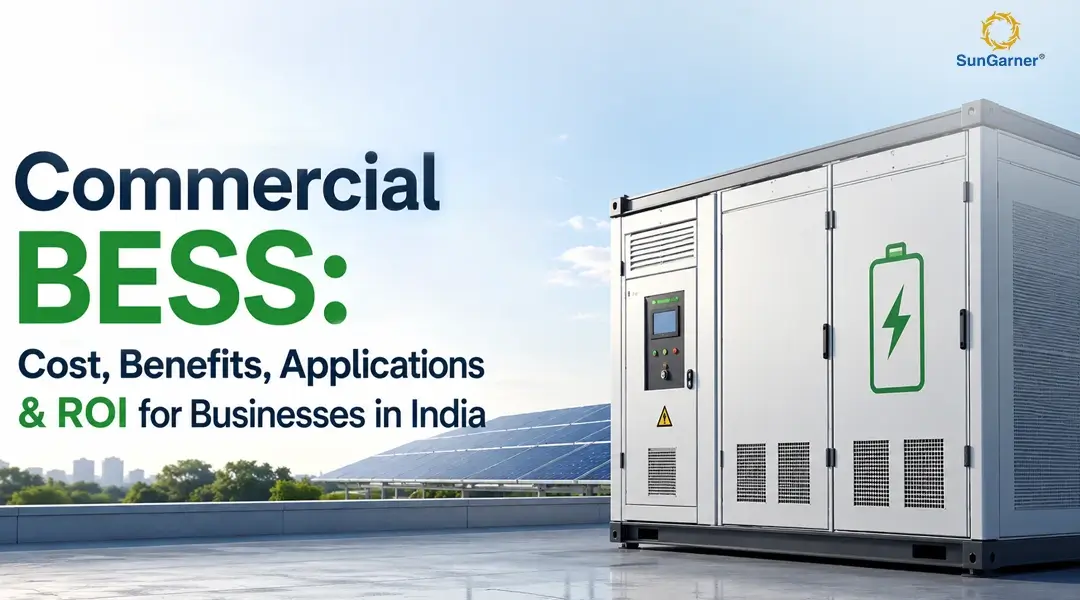
Commercial BESS: Cost, Benefits, Applications & ROI for Businesses in India
Electricity is one of the largest recurring operating costs for many commercial and industrial businesses.
Factories, warehouses, hospitals, hotels, offices, shopping centres, data centres, telecom facilities and other C&I consumers may experience high electricity costs because of energy consumption, peak demand, time-of-day tariffs, power-quality requirements and the need for reliable backup.
Traditionally, businesses have addressed these challenges through grid power, diesel generators and conventional battery backup.
But the energy landscape is changing.
A Commercial Battery Energy Storage System (BESS) can do much more than provide backup power. It can store electricity and intelligently discharge it when the business needs it most.
Depending on the system design and tariff structure, commercial BESS can be used for:
- Peak-demand management
- Energy time shifting
- Solar energy storage
- Solar self-consumption
- Backup power
- Load management
- Energy arbitrage
- Diesel-generator reduction
- Renewable-energy integration
- Power-quality support
- Microgrid applications
India's Ministry of Power has also introduced policy measures to accelerate energy storage, including VGF schemes and other measures supporting BESS deployment.
This makes BESS increasingly relevant for businesses that want to move from simply consuming electricity to actively managing when and how electricity is consumed.
What Is Commercial BESS?
A Commercial Battery Energy Storage System (BESS) is an integrated battery-storage solution designed for businesses and commercial or industrial facilities.
It stores electricity and releases it later according to the facility's operational requirements.
Unlike a conventional inverter battery system that is primarily designed for backup, a commercial BESS can operate as an intelligent energy-management asset.
A typical BESS includes:
- Battery cells and modules
- Battery Management System (BMS)
- Power Conversion System (PCS)
- Energy Management System (EMS)
- Thermal management
- Fire detection and protection
- Switchgear and protection equipment
- Transformer, where required
- Monitoring and communication systems
The complete architecture can be:
Grid + Solar → PCS → BESS → Load
or:
Solar → Load + BESS → Load
depending on the project configuration.
SunGarner's commercial and industrial BESS capabilities include system design and engineering, lithium-battery integration, installation and commissioning, remote monitoring and maintenance.
How Does a Commercial BESS Work?
The simplest way to understand BESS is to think of it as an intelligent electricity-storage and dispatch system.
During low-demand or low-cost periods:
Grid/Solar → BESS Charging
During high-demand periods:
BESS → Load
During solar generation:
Solar → Load
Any suitable surplus can be directed to:
Solar → BESS
During a grid outage:
BESS → Critical Loads
if the system has been designed with the required backup and islanding capability.
The EMS determines when the battery should charge or discharge based on programmed operating conditions.
This means a commercial BESS can potentially optimise energy use instead of simply switching on during an outage.
Commercial BESS vs Conventional Battery Backup
This is an important distinction for businesses.
|
Feature |
Conventional Battery Backup |
Commercial BESS |
|
Primary purpose |
Backup |
Energy management + backup |
|
Peak shaving |
Limited |
Yes |
|
Solar integration |
Possible |
Yes |
|
Energy time shifting |
Limited |
Yes |
|
Demand management |
Limited |
Yes |
|
EMS |
Usually limited |
Advanced |
|
Large-scale operation |
Limited |
Designed for C&I applications |
|
Grid interaction |
Basic |
Advanced, project-dependent |
|
Monitoring |
Basic |
Advanced |
|
Multiple revenue/value streams |
Limited |
Possible |
A business should therefore not compare commercial BESS with a normal inverter-battery system only on battery price.
The correct comparison is based on total energy value over the system's operating life.
Commercial BESS Cost in India
One of the most important questions for businesses is:
“How much does a commercial BESS cost in India?”
There is no universal BESS price because commercial storage projects are engineered according to the facility's load profile and application.
Current market estimates place commercial and industrial BESS systems broadly in the range of ₹40,000–₹60,000 per kWh for systems from approximately 50 kWh to 5 MWh, although actual pricing varies by region, manufacturer, technology and project configuration.
However, businesses should treat any ₹/kWh figure as an initial budgeting benchmark, not a final EPC quotation.
Why?
A 1 MW / 1 MWh BESS and a 1 MW / 4 MWh BESS have the same power rating but four times the energy capacity.
Similarly, two 1 MWh BESS projects can have different costs because of:
- PCS rating
- Battery chemistry
- Storage duration
- Container/enclosure
- HVAC
- Fire safety
- Transformer
- Switchgear
- Civil work
- Grid integration
- EMS
- Installation
- Warranty
- Monitoring
- O&M
- Augmentation requirements
Indicative Budgeting Example
Using ₹40,000–₹60,000/kWh only as a broad preliminary benchmark:
|
BESS Capacity |
Indicative Benchmark |
|
100 kWh |
₹40–60 lakh |
|
250 kWh |
₹1–1.5 crore |
|
500 kWh |
₹2–3 crore |
|
1 MWh |
₹4–6 crore |
Important: These are mathematical budgeting illustrations, not final project quotations. Actual project pricing may differ substantially depending on system configuration, scale, technology, EPC scope and market conditions.
For large C&I systems, the ₹/kWh cost can fall with scale, while power rating and balance-of-system requirements can materially affect the final project cost.
What Determines Commercial BESS Cost?
Businesses should understand the complete cost structure before comparing quotations.
1. Battery Cells and Modules
The battery is generally the largest component of a BESS.
Lithium-ion technology, particularly LFP chemistry, is widely used for modern stationary storage because of its combination of safety characteristics, cycle performance and energy density.
2. PCS – Power Conversion System
PCS controls bidirectional energy flow between the battery and AC system.
A higher-power PCS can increase the project's cost, but it may be essential for applications such as peak shaving.
This is why:
kW/MW = How fast energy can be delivered
while:
kWh/MWh = How much energy can be stored
Both numbers matter.
3. BMS – Battery Management System
The BMS monitors and manages battery operating parameters such as:
- Voltage
- Current
- Temperature
- State of charge
- Cell balancing
- Battery protection
4. EMS – Energy Management System
EMS determines how the BESS interacts with:
- Solar
- Grid
- Loads
- Generator
- Battery
An intelligent EMS is particularly important when BESS is being used for multiple applications.
5. Thermal Management
Large battery systems require appropriate thermal management to maintain operating conditions and system performance.
6. Fire and Safety Systems
Commercial BESS installations require appropriate safety engineering, which can include:
- Detection
- Alarm systems
- Fire suppression
- Ventilation
- Emergency shutdown
- Protection systems
The exact requirements depend on system design, site conditions and applicable standards.
7. Installation and Civil Infrastructure
Costs can include:
- Foundation
- Cabling
- Transportation
- Installation
- Earthing
- Electrical infrastructure
- Transformer
- Switchgear
- Commissioning
8 Major Applications of Commercial BESS
1. Peak Shaving
Peak shaving is one of the most important commercial BESS applications.
A business may experience short periods of very high electricity demand.
For example, several large loads may start simultaneously:
- Motors
- HVAC systems
- Chillers
- Compressors
- Pumps
- Production equipment
If these peaks contribute to demand charges under the applicable tariff structure, reducing them can lower electricity costs.
A BESS can discharge during targeted peak periods.
Simple Example
Suppose a facility has:
Peak demand = 1,000 kW
and the business wants to reduce the peak by:
200 kW
A BESS capable of delivering approximately 200 kW could potentially support this objective, subject to the facility's load profile and control strategy.
The required energy capacity then depends on how long the peak lasts.
If the targeted peak lasts for 2 hours:
200 kW × 2 hours = 400 kWh
The actual BESS would need additional design margin based on usable capacity, efficiency, reserve and degradation.
2. Solar Energy Storage
Solar generation is strongest during daylight hours.
But many businesses also consume electricity:
- In the evening
- At night
- During cloudy periods
- During production shifts outside solar-generation hours
BESS can store suitable surplus solar energy and discharge it later.
The basic operating model becomes:
Solar → Business Load
plus:
Solar Surplus → BESS
followed by:
BESS → Business Load
This can increase the useful utilisation of on-site solar generation.
3. Solar Self-Consumption
Businesses with rooftop solar may produce more electricity than they can immediately consume at certain times.
Instead of allowing all surplus energy to go elsewhere, a BESS can store some of that energy, subject to the applicable electrical and regulatory configuration.
This can be particularly useful for businesses whose load profile extends into evening hours.
4. Time-of-Day Energy Shifting
Some electricity tariffs vary by time period.
A BESS can potentially:
Charge during lower-cost periods
and
Discharge during higher-cost periods
This is commonly called energy arbitrage or time shifting.
The economics depend on:
- Tariff difference
- Battery efficiency
- Battery degradation
- Number of cycles
- Applicable charges
- EMS strategy
The tariff spread must be large enough to justify the cost of cycling the battery.
5. Backup Power for Critical Loads
Businesses often do not need to back up their entire facility.
Instead, they may identify critical loads such as:
- Server rooms
- Security systems
- Emergency lighting
- Telecom equipment
- Medical equipment
- Refrigeration
- Control systems
- Critical manufacturing processes
The BESS can be designed to support these selected loads.
Backup Energy Calculation
Required Energy = Critical Load × Required Backup Duration
For example:
300 kW × 2 hours = 600 kWh
This is the theoretical energy requirement before considering efficiency, reserve and usable battery capacity.
6. Diesel Generator Reduction
Many businesses rely on diesel generators during grid interruptions.
BESS can potentially reduce generator runtime in suitable applications.
A hybrid architecture can be:
Solar + BESS + Grid + DG
The EMS can determine which source should operate based on:
- Grid availability
- Solar generation
- Battery SOC
- Load
- Fuel cost
- Operating strategy
This can reduce diesel consumption and emissions where the system is properly engineered.
7. Microgrid Applications
Commercial BESS can form an important component of a microgrid.
A typical microgrid may combine:
Solar + BESS + Grid + DG + Loads
This architecture is particularly relevant for:
- Industrial campuses
- Hospitals
- Universities
- Data centres
- Remote facilities
- Large commercial complexes
The objective is to improve energy resilience and operational flexibility.
8. Power Quality and Grid Support
Depending on PCS and system configuration, BESS can support certain power-quality and grid-related functions.
Potential applications include:
- Voltage support
- Frequency response
- Fast power response
- Reactive power support
- Load balancing
These applications depend heavily on the electrical architecture and applicable grid requirements.
Commercial BESS Benefits for Businesses
Lower Electricity Costs
The most obvious potential benefit is reducing electricity expenditure through:
- Peak shaving
- Energy shifting
- Solar self-consumption
- Reduced grid consumption
- Reduced diesel usage
Better Solar Utilisation
Instead of limiting solar's value to the time when the sun is shining, BESS can shift stored energy to later periods.
Improved Energy Resilience
BESS can provide fast-response backup to designated critical loads when designed for this purpose.
Reduced Diesel Dependence
For suitable facilities, BESS can reduce generator runtime and fuel consumption.
Greater Energy Flexibility
A business gains an additional controllable energy asset between generation and consumption.
Lower Carbon Footprint
Replacing some grid or diesel electricity with stored renewable energy can support emissions-reduction objectives.
Better Control Over Energy Consumption
EMS enables businesses to make energy decisions based on:
- Load
- Tariff
- Solar generation
- Battery SOC
- Grid availability
rather than consuming electricity passively.
Commercial BESS ROI: Is Battery Storage Profitable for Businesses?
BESS ROI is highly site-specific.
There is no responsible way to promise a universal “3-year ROI” or “5-year payback” for every business.
The financial case depends on the number and value of applications the battery can perform.
A useful approach is to calculate the annual value created by each BESS application.
Annual BESS Value Can Include:
Peak-Demand Savings
Time-of-Day / Energy-Arbitrage Savings
Solar Self-Consumption Value
Diesel-Fuel Savings
Backup / Reliability Value
Annual O&M Cost
Other Operating Costs
Simple Commercial BESS Payback Formula
A basic calculation is:
Simple Payback Period = Total BESS Investment ÷ Annual Net Savings
Example
Assume:
BESS investment = ₹2 crore
and:
Annual net savings = ₹50 lakh
Then:
Simple Payback = ₹2 crore ÷ ₹50 lakh = 4 years
This is only a simplified illustration.
A professional investment model should also include:
- Battery degradation
- Round-trip efficiency
- Annual cycles
- Tariff escalation
- O&M
- Financing cost
- Tax treatment
- Warranty
- Battery augmentation
- Replacement assumptions
- Residual value
For large projects, businesses should evaluate NPV, IRR and LCOS rather than relying only on simple payback.
What Is LCOS in BESS?
LCOS stands for Levelized Cost of Storage.
It represents the average cost of delivering stored electricity over the useful life of the storage system.
LCOS considers factors such as:
- Initial CAPEX
- Charging energy
- Efficiency losses
- O&M
- Battery degradation
- Replacement or augmentation
- Total discharged energy
This is useful because two BESS systems with identical upfront prices may have completely different lifetime economics.
Why BESS ROI Depends on the Load Profile
Consider two factories.
Factory A
- High electricity consumption during solar hours
- Very little evening consumption
- Low peak-demand charges
Factory B
- Moderate daytime consumption
- High evening consumption
- Significant demand charges
- Frequent short-duration peaks
A BESS may create substantially more value for Factory B, even if both facilities consume the same amount of electricity annually.
This is why a BESS feasibility study should begin with 15-minute or 30-minute interval load data, where available, rather than simply looking at the monthly electricity bill.
How to Size a Commercial BESS
BESS sizing has two fundamental dimensions:
Power Capacity
Measured in:
kW / MW
This determines how much power the BESS can deliver or absorb at a given moment.
Energy Capacity
Measured in:
kWh / MWh
This determines how much energy the BESS can store.
Example
A:
500 kW / 1 MWh BESS
can theoretically discharge:
500 kW for 2 hours
under simplified conditions.
A:
500 kW / 2 MWh BESS
could theoretically provide:
500 kW for 4 hours
before accounting for usable capacity, efficiency and operating reserves.
Therefore, businesses should never ask only:
“How many kWh of battery do I need?”
They should ask:
“How many kW do I need, for how many hours, and for what application?”
Key Data Required for BESS Sizing
A professional BESS assessment should examine:
- Monthly electricity bills
- 15-minute or 30-minute load data
- Contract demand
- Maximum demand
- Time-of-day tariff
- Solar generation profile
- Critical loads
- Required backup duration
- Grid outage history
- Diesel-generator capacity
- Available installation area
- Future load growth
- Battery operating strategy
This data allows the system to be optimised for the business rather than simply selecting a standard battery package.
Commercial BESS Chemistry: Why LFP Is Commonly Considered
Lithium-ion batteries are widely used in modern BESS projects.
Among lithium-ion technologies, Lithium Iron Phosphate (LFP) is commonly considered for stationary storage because of its combination of:
- Safety characteristics
- Cycle performance
- Thermal stability
- Suitable energy density
- Long operating life
However, the correct battery technology should be selected based on the application's:
- Duration
- Cycling profile
- Temperature
- Space constraints
- Safety requirements
- Warranty
- Cost
- Performance requirements
The cheapest battery is not necessarily the lowest-cost BESS over its lifetime.
What Components Should a Commercial BESS Include?
A complete commercial BESS can include:
Battery System
Cells, modules, racks and battery packs.
BMS
Monitors and protects the battery.
PCS
Converts energy between AC and DC.
EMS
Controls system operation and energy dispatch.
HVAC/Thermal Management
Maintains suitable operating temperatures.
Fire Safety
Provides detection, alarms and appropriate suppression/protection.
Transformer
Used where voltage conversion is required.
Switchgear
Provides electrical isolation and protection.
Monitoring System
Provides real-time visibility into:
- SOC
- SOH
- Voltage
- Current
- Power
- Temperature
- Alarms
- Energy flow
Commercial BESS Applications by Business Type
|
Business |
Potential BESS Applications |
|
Manufacturing |
Peak shaving, solar shifting, backup |
|
Warehouses |
Solar self-consumption, peak management |
|
Hotels |
Peak shaving, solar storage, backup |
|
Hospitals |
Critical-load backup, resilience |
|
Data Centres |
Backup, power-quality support, energy management |
|
Telecom |
Backup and renewable integration |
|
Shopping Malls |
Peak management, solar shifting |
|
Cold Storage |
Solar storage, backup |
|
Offices |
Solar self-consumption, peak management |
|
Educational Campuses |
Solar storage, microgrid, backup |
|
Industrial Parks |
Peak management, microgrid applications |
Commercial Solar + BESS: A Powerful Combination
Businesses installing solar should not evaluate BESS separately from their solar strategy.
The two technologies can complement each other.
Solar Only
Solar → Daytime Load
Solar + BESS
Solar → Daytime Load
Solar Surplus → BESS
BESS → Evening/Peak Load
This can improve the utilisation of solar energy and provide additional flexibility.
For businesses with suitable load profiles, the combination can potentially create value through:
- Higher solar self-consumption
- Reduced peak demand
- Evening energy supply
- Backup power
- Reduced grid dependency
India's power-sector policy direction increasingly recognises storage as an important component of renewable-energy integration. The Ministry of Power has reported VGF support for BESS and other measures designed to make storage more economical and scalable.
Government Support and BESS Policy in India
India has introduced several policy measures to encourage energy storage deployment.
The Ministry of Power has reported:
- VGF schemes supporting BESS development
- A VGF scheme for additional BESS capacity
- Transmission-charge measures for eligible BESS projects
- Competitive-bidding guidelines for procurement of storage capacity and stored energy
For example, the government reported VGF support for 13,220 MWh of BESS capacity and an additional scheme supporting 30 GWh of BESS capacity.
The Ministry has also issued guidelines covering procurement and utilisation of BESS as part of generation, transmission and distribution assets, as well as guidelines for firm and dispatchable renewable power with storage.
However, businesses should distinguish between grid-scale policy support and incentives directly available to an individual C&I consumer installing a behind-the-meter BESS.
Applicable state electricity regulations, DISCOM rules, project configuration and ownership model should always be checked before making an investment decision.
Commercial BESS vs Diesel Generator
|
Parameter |
Diesel Generator |
BESS |
|
Fuel required |
Diesel |
Electricity |
|
Local emissions |
Yes |
No during discharge |
|
Noise |
High |
Low |
|
Response time |
Seconds/minutes |
Very fast |
|
Solar integration |
Limited |
Excellent |
|
Peak shaving |
No |
Yes |
|
Energy shifting |
No |
Yes |
|
Maintenance |
Regular mechanical maintenance |
Battery/electrical O&M |
|
Fuel-price exposure |
High |
Lower |
|
Long-duration backup |
Strong |
Depends on battery capacity |
For many commercial facilities, the most practical solution may not be BESS instead of DG, but:
Solar + BESS + DG + Grid
Each resource can perform a different role.
How to Choose the Right Commercial BESS Supplier
Price should not be the only selection criterion.
Before purchasing a BESS, businesses should evaluate:
Technical Capability
- BESS architecture
- Battery technology
- PCS integration
- BMS
- EMS
- Thermal management
- Fire safety
- Grid integration
Financial Capability
- CAPEX
- O&M cost
- Warranty
- Degradation
- Augmentation
- Total cost of ownership
- Expected savings
Execution Capability
- EPC experience
- Installation
- Commissioning
- Testing
- Remote monitoring
- O&M support
Warranty
Check:
- Battery warranty
- Capacity-retention guarantee
- PCS warranty
- Performance guarantee
- Availability guarantee
- Response time
- Replacement terms
8 Mistakes to Avoid Before Installing a Commercial BESS
1. Buying Battery Capacity Without Analysing the Load
A bigger battery is not automatically a better investment.
2. Looking Only at ₹/kWh
The cheapest battery may have higher degradation, lower efficiency or weaker warranty conditions.
3. Ignoring Power Rating
A battery may have sufficient kWh but insufficient kW to handle the required peak load.
4. Ignoring Tariff Structure
If the business has no meaningful peak or time-of-day savings opportunity, the BESS ROI may be weaker.
5. Oversizing Backup Capacity
Backing up every facility load can dramatically increase CAPEX.
Critical-load identification can produce a more economical design.
6. Ignoring Solar Generation
For businesses with existing or planned solar, BESS should be designed around the solar generation and load profiles together.
7. Not Considering Battery Degradation
The battery's usable capacity decreases over its operating life.
Financial models should account for degradation and any required augmentation.
8. Choosing a Supplier Only on Initial Price
A BESS is a long-term energy asset.
System availability, safety, warranty, monitoring, O&M and performance can be more important than a small difference in initial CAPEX.
Is Commercial BESS Worth It for Businesses in India?
Commercial BESS can be financially attractive when the facility has one or more strong value drivers:
High demand charges
Large peak loads
High evening electricity consumption
Significant solar surplus
Frequent grid interruptions
High diesel-generator usage
Time-of-day tariff differences
Critical loads requiring resilient power
The stronger the combination of these factors, the stronger the potential business case.
A recent C&I-focused market analysis also highlights peak shaving as a major driver of BESS economics and emphasises that power rating can be as important as energy capacity when designing a system for demand management.
At the same time, businesses should not assume that every BESS project will achieve the same payback. Current industry analysis stresses that project economics depend heavily on execution, tariff structure, load profile and bankability.
The Future of Commercial BESS in India
India's electricity system is becoming increasingly renewable and increasingly dependent on flexibility.
The Central Electricity Authority's National Electricity Plan has projected substantial BESS requirements as renewable generation expands. Its scenario analysis shows BESS requirements varying significantly by demand and generation assumptions, illustrating the growing importance of storage in India's future power system.
For businesses, this transition creates a new opportunity.
Instead of viewing electricity simply as:
Grid → Business
the future energy architecture can become:
Solar + Grid + BESS + DG → Intelligent Energy Management → Business
BESS can become the control layer between energy generation, storage and consumption.
That makes commercial storage more than a backup technology.
It becomes an energy-management asset.
Final Takeaway: Commercial BESS Is More Than Battery Backup
The business case for commercial BESS is no longer limited to keeping the lights on during a power outage.
A properly designed BESS can help businesses:
- Reduce peak demand
- Shift energy consumption
- Increase solar utilisation
- Reduce electricity costs
- Reduce diesel consumption
- Support critical loads
- Improve energy resilience
- Manage renewable energy more effectively
But the right BESS is not necessarily the largest battery or the lowest-cost battery.
The right system is the one designed around the business's actual:
Load Profile + Tariff + Peak Demand + Solar Generation + Critical Loads + Backup Requirement + Future Energy Demand
For commercial and industrial consumers, the first step should therefore be a load-profile and techno-economic assessment, followed by BESS sizing, system architecture and financial modelling.
Frequently Asked Questions
What is a commercial BESS?
A commercial BESS is a Battery Energy Storage System designed to store and supply electricity for commercial and industrial facilities. It can be used for peak shaving, solar storage, energy shifting, backup and other energy-management applications.
What is the difference between kW and kWh in BESS?
kW represents the power the battery can deliver or absorb at a given time.
kWh represents the amount of energy the battery can store.
For example, a 500 kW / 1 MWh BESS can theoretically deliver 500 kW for approximately two hours under simplified operating conditions.
Can BESS be integrated with existing solar?
Yes. A properly engineered BESS can be integrated with an existing or new solar PV system, depending on the inverter architecture and electrical configuration.
Can BESS reduce electricity bills?
Yes, potentially. Savings can come from peak-demand reduction, energy shifting, solar self-consumption and reduced diesel usage. Actual savings depend on the tariff and facility load profile.
Can commercial BESS replace a diesel generator?
In some applications, BESS can reduce or partially replace diesel-generator operation. However, whether it can replace a DG entirely depends on backup duration, critical load, grid configuration and site requirements.
How long does a commercial BESS last?
Battery life depends on chemistry, cycling, temperature, depth of discharge, operating strategy and warranty conditions. Businesses should evaluate the manufacturer's cycle-life and capacity-retention warranty rather than relying on a generic lifespan figure.
What is peak shaving in BESS?
Peak shaving means using stored battery energy during high-demand periods to reduce the facility's maximum grid demand.
What is solar-plus-BESS?
Solar-plus-BESS combines photovoltaic generation with battery storage. Solar power can serve the load directly, while suitable surplus generation can charge the battery for later use.
Is BESS suitable for every business?
No. BESS economics depend on the business's load profile, tariff, peak demand, solar generation, outage requirements and operating schedule. A feasibility study should be completed before selecting the system size.
Looking for a Commercial BESS Solution?
SunGarner provides BESS system design and engineering, lithium-battery integration, installation and commissioning, remote monitoring and maintenance for C&I and IPP applications.
Speak with the SunGarner team to evaluate your facility's load profile, peak demand, solar generation, backup requirements and potential BESS ROI before finalising the system capacity.