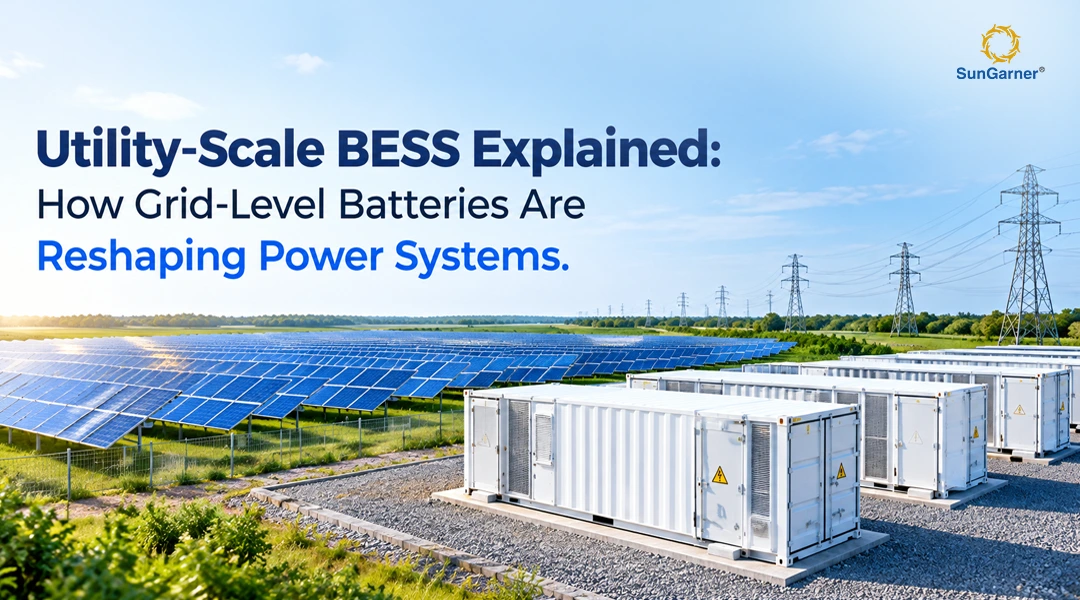
Utility-Scale BESS Explained: How Grid-Level Batteries Are Reshaping Power Systems
As electricity demand increases and renewable energy becomes a larger part of the power mix, maintaining a reliable and stable electricity grid is becoming more complex. Solar and wind power offer significant opportunities for clean electricity generation, but their output varies with weather conditions, time of day and seasonal patterns.
Utility-scale Battery Energy Storage Systems (BESS) are emerging as a key technology for addressing these challenges. By storing electricity when it is available and releasing it when demand increases, grid-level batteries help balance electricity supply and demand, support renewable energy integration and improve power system flexibility.
From large solar parks to transmission networks, utility-scale BESS is transforming how electricity is stored, managed and delivered.
In this guide, we explain what utility-scale BESS is, how grid-level battery storage works, its major applications, benefits, challenges and role in India's evolving energy landscape.
1. What Is Utility-Scale BESS?
A utility-scale Battery Energy Storage System (BESS) is a large battery installation designed to store and discharge electricity for the power grid. Unlike residential battery systems that typically supply an individual home, utility-scale BESS operates at a much larger capacity to support utilities, grid operators, renewable energy developers and electricity markets.
These systems can be installed alongside solar and wind farms or connected directly to transmission and distribution networks.
A utility-scale BESS typically consists of battery containers, power conversion equipment, battery management systems, energy management software, thermal management systems and grid connection infrastructure.
Its primary function is to shift electricity from one time period to another. The system charges when electricity is available or economical and discharges when electricity demand, grid conditions or market prices make stored energy valuable.
For example, a battery connected to a solar power plant can store surplus electricity generated during the afternoon and deliver it to the grid during the evening peak-demand period.
This helps reduce the mismatch between renewable energy generation and electricity consumption.
Utility-Scale BESS vs. Residential Battery Storage
|
Feature |
Utility-scale BESS |
Residential BESS |
|
Primary purpose |
Grid support and bulk energy storage |
Home backup and self-consumption |
|
Typical scale |
MWh to GWh |
kWh |
|
Grid connection |
Utility or high-voltage infrastructure |
Home or building electrical system |
|
Main users |
Utilities, IPPs, grid operators |
Homeowners and businesses |
|
Applications |
Grid balancing, peak shifting, renewable integration |
Backup power, bill optimization |
Utility-scale BESS is therefore an important part of modern electricity infrastructure rather than simply a larger version of a home battery.
2. How Does a Utility-Scale Battery Energy Storage System Work?

The working principle of a grid-scale battery energy storage system is straightforward: electricity is converted into a form that batteries can store, retained until required, and then converted back into electricity for the grid.
Step 1: Charging the Battery
Electricity enters the BESS from a connected source. This may include a solar power plant, wind farm or the electricity grid.
The power conversion system regulates the electrical power supplied to the batteries during charging.
Step 2: Storing Energy
The battery cells store energy through electrochemical reactions. Multiple cells are assembled into modules, racks and larger battery enclosures to achieve the required capacity.
The system monitors battery conditions throughout the charging process.
Step 3: Monitoring and Control
The Battery Management System (BMS) monitors parameters such as cell voltage, temperature, state of charge and battery health.
The Energy Management System (EMS) determines when the battery should charge or discharge, based on grid requirements, renewable energy output, electricity prices and operating limits.
Step 4: Discharging Electricity
When electricity is required, the battery releases stored energy as direct current (DC). The Power Conversion System (PCS) converts it into alternating current (AC), which can be synchronized with the grid.
Transformers and switchgear help connect the system to the required grid voltage.
Step 5: Supporting Grid Operations
The battery can then deliver electricity during peak demand, respond to grid frequency deviations, support renewable energy output or provide other contracted services.
The operating strategy depends on the project's technical design, grid requirements and commercial arrangements.
Understanding MW and MWh in Utility-Scale BESS
Two measurements are essential when evaluating a battery storage project:
- Megawatts (MW): The maximum power the system can deliver or absorb at a given moment.
- Megawatt-hours (MWh): The amount of energy the system can store and deliver over time.
For example, a 100 MW / 200 MWh BESS can theoretically discharge at 100 MW for two hours when starting with a full usable energy reserve, before accounting for operating limits and losses.
This distinction is essential when comparing battery storage projects because power capacity and energy capacity determine different aspects of system performance.
3. Key Components of a Utility-Scale BESS
A utility-scale battery energy storage system integrates multiple electrical, mechanical and digital components. Each plays a specific role in ensuring safe, reliable and efficient operation.
3.1 Battery Cells and Battery Racks
Battery cells are the core energy storage units. They are assembled into modules and racks, which are installed in containers or dedicated enclosures.
Lithium iron phosphate (LFP) batteries are widely used in stationary storage applications because of their cycle-life characteristics and thermal stability relative to some other lithium-ion chemistries. Other technologies, including nickel manganese cobalt (NMC) and flow batteries, may also be considered depending on project requirements.
3.2 Battery Management System (BMS)
The BMS monitors and protects the battery system. Its functions include:
- Monitoring cell voltage and temperature.
- Managing charging and discharging limits.
- Balancing cells within battery packs.
- Estimating state of charge and battery health.
- Detecting abnormal operating conditions.
A properly designed BMS helps protect battery assets and supports long-term system performance.
3.3 Power Conversion System (PCS)
The PCS converts electricity between AC and DC. It enables batteries to charge from the grid or a renewable energy source and discharge electricity into the AC network.
The PCS also supports grid-interface functions, subject to its capabilities and applicable grid-code requirements.
3.4 Energy Management System (EMS)
The EMS coordinates battery operation using information such as electricity prices, grid demand, renewable generation forecasts, battery availability and contractual requirements.
For a grid-connected BESS, the EMS is particularly important because operating the battery at the right time can affect both grid performance and project revenue.
3.5 Thermal Management and Fire Protection
Battery systems require controlled operating temperatures. Cooling equipment helps manage heat generated during charging and discharging.
Fire detection, isolation, suppression and emergency response provisions must be designed for the battery chemistry, enclosure, installation and applicable safety requirements.
3.6 Transformers, Switchgear and Grid Connection
Transformers adjust voltage levels for grid integration, while switchgear and protection systems isolate faults and support safe operation.
The interconnection design must also address metering, power quality, grounding, communications and grid protection requirements.
4. Major Applications of Grid-Scale Battery Storage
Utility-scale BESS can deliver multiple services across electricity generation, transmission and distribution. Its flexibility allows the same asset to serve different operational needs, subject to its capacity, location, contracts and available energy.
4.1 Renewable Energy Integration
Batteries store surplus solar or wind generation and release it when renewable output declines. This helps reduce the mismatch between variable generation and electricity demand.
4.2 Peak Shaving and Load Shifting
A BESS can charge during lower-demand periods and discharge during peak hours. This can reduce peak grid requirements and shift energy delivery to periods of greater demand.
4.3 Frequency Regulation
Grid-connected batteries can respond rapidly to frequency deviations by adjusting charging or discharging power. This helps balance supply and demand in real time.
4.4 Transmission and Distribution Support
Batteries located near constrained substations or transmission corridors can help manage power flows and potentially defer certain network upgrades.
4.5 Energy Arbitrage
Where market rules permit, operators can charge when electricity prices are relatively low and discharge when prices are higher. The financial benefit depends on price differences, efficiency, degradation and operating costs.
5. How Utility-Scale BESS Is Reshaping Power Systems
Traditional electricity systems are designed around the continuous balancing of generation and consumption. Grid-scale batteries introduce additional flexibility by allowing electricity to be consumed at one time and delivered at another.
Making Renewable Energy More Dispatchable
Solar and wind output depends on environmental conditions. Battery storage can make renewable electricity more flexible by shifting some of its delivery to periods when it is needed.
However, storage does not generate additional energy. It consumes energy while charging and returns less energy during discharge because of conversion and battery losses.
Improving Grid Flexibility
BESS can change its power output quickly, making it useful for balancing short-term variations in electricity supply and demand.
This capability becomes increasingly valuable as the share of variable renewable generation rises.
Reducing Grid Congestion
A strategically located battery may charge when a network has available capacity and discharge when a constrained network corridor is under pressure.
The benefit depends on where the battery is connected and how the grid is operated. Storage cannot eliminate every transmission constraint.
Supporting Electricity Reliability
Battery storage can provide rapid-response power and, when properly designed, certain backup or restoration services. Some systems can support black-start operations, but this requires suitable equipment, controls and grid arrangements.
The result is a more flexible power system in which generation, storage and network infrastructure can work together.
6. Utility-Scale BESS in India: Market Growth and Opportunities
India's growing electricity demand and expanding renewable energy capacity are increasing the importance of energy storage.
According to the Ministry of New and Renewable Energy's overview of energy storage, the Central Electricity Authority's National Electricity Plan projects a BESS requirement of approximately 236.22 GWh by 2031–32, alongside a separate requirement for pumped-storage hydropower.
The opportunity is not limited to renewable energy developers. It extends to utilities, transmission and distribution companies, independent power producers, battery manufacturers and system integrators.
Key growth areas include:
- Standalone BESS projects: Battery installations connected directly to the grid.
- Solar-plus-storage projects: Systems that store excess solar generation for later use.
- Wind-plus-storage projects: Systems that help manage variability in wind generation.
- Hybrid renewable projects: Combined solar, wind and storage configurations designed to deliver power across a wider range of hours.
- Grid-support applications: Storage deployed to provide balancing, frequency response and network services.
The Central Electricity Authority also publishes project-level updates on the development and deployment of BESS in India, providing a useful reference for tracking the sector.
Government Support and Regulatory Developments
India has introduced policy and regulatory measures intended to facilitate energy storage deployment. These include recognition of energy storage within the power system framework, planning provisions and initiatives to support project development.
The Ministry of Power has also highlighted the role of storage in renewable integration and grid services. Project developers should review the latest applicable central and state regulations, tender conditions, grid codes and safety requirements before making investment decisions.
7. Utility-Scale BESS Cost and Project Economics
The cost of a utility-scale BESS depends on more than the price of battery cells. A complete project budget must account for the battery system, power conversion equipment, electrical infrastructure, installation, land, grid interconnection and commissioning.
The main cost factors include:
|
Cost factor |
Impact on project economics |
|
Battery capacity (MWh) |
Determines the quantity of energy storage |
|
Power rating (MW) |
Influences PCS and electrical equipment sizing |
|
Battery chemistry |
Affects performance, safety and lifecycle costs |
|
Project duration |
Influences the required energy capacity |
|
Grid interconnection |
Depends on voltage, distance and network requirements |
|
Operation and maintenance |
Includes servicing, monitoring and repairs |
|
Battery replacement |
Depends on degradation, usage and warranty terms |
What Determines BESS Project ROI?
The financial performance of a battery storage project depends on how effectively it converts its technical capabilities into economic value.
Important considerations include:
- Revenue streams: Energy arbitrage, capacity payments and grid services, where available.
- Round-trip efficiency: The proportion of charging energy recovered during discharge.
- Battery degradation: The gradual reduction in usable capacity over time.
- Utilization: How frequently and intensively the system operates.
- Financing costs: Interest rates, capital structure and project tenure.
- Contract structure: Guaranteed payments, performance obligations and penalties.
A project may generate value through several services, often described as value stacking. However, these revenue streams cannot always be combined freely. Contractual restrictions, battery availability and competing operating requirements may limit simultaneous participation.
For this reason, developers should evaluate BESS projects using lifecycle cash-flow models rather than relying only on the initial battery price or a simple payback estimate.
8. Challenges in Utility-Scale Battery Energy Storage
Despite its potential, utility-scale BESS involves several technical and commercial challenges.
High Initial Investment
Battery systems require substantial upfront capital. Project viability depends on equipment costs, financing, revenue certainty and the value of the services provided.
Battery Degradation
Repeated charging and discharging gradually affect battery capacity. High temperatures, operating conditions and charging patterns can influence degradation.
Safety and Thermal Management
Battery installations require suitable thermal controls, fire detection, emergency isolation and site-specific safety planning. Poor system integration or inadequate protection can increase operational risks.
Grid Integration and Interconnection
Developers must meet applicable grid codes, protection requirements, power-quality standards and utility interconnection conditions.
Supply Chain and Recycling
Battery projects depend on the availability of cells, power electronics and other components. End-of-life battery management, recycling and responsible material recovery are also important considerations.
Addressing these challenges requires coordinated planning across battery manufacturing, electrical engineering, system integration, project financing and operations.
9. The Future of Utility-Scale BESS
The future of grid-scale battery storage will depend on continued improvements in battery technology, project costs, energy management software and electricity market design.
Several developments are shaping the sector:
- Longer-duration storage: Systems designed to deliver electricity over longer periods.
- Advanced energy management: Software that optimizes charging and discharging using forecasts and grid conditions.
- Hybrid renewable projects: Greater coordination between solar, wind and storage assets.
- Grid-forming inverters: Technologies that can provide voltage and frequency support in appropriately designed systems.
- Battery lifecycle management: Better monitoring, maintenance, refurbishment and recycling practices.
Lithium-ion batteries are likely to remain an important technology for many applications, while alternatives such as flow batteries and other long-duration storage technologies may serve particular use cases.
The choice of technology will depend on discharge duration, operating conditions, safety requirements, project economics and the services required by the grid.
10. How to Choose a Utility-Scale BESS Solution
Selecting a utility-scale BESS requires a clear understanding of the project's technical requirements and commercial objectives.
Before choosing a system, developers and utilities should evaluate the following:
- Define the application: Identify whether the system will provide renewable energy shifting, peak shaving, frequency regulation or multiple services.
- Determine power and energy requirements: Establish the required MW rating, MWh capacity and discharge duration.
- Assess battery technology: Compare cycle life, efficiency, safety, degradation and warranty conditions.
- Review system integration: Evaluate the BMS, PCS, EMS, thermal management and grid connection design.
- Verify safety and compliance: Check applicable electrical standards, fire protection requirements and grid codes.
- Evaluate lifecycle economics: Consider capital costs, operating expenses, degradation, augmentation and end-of-life management.
- Assess supplier capabilities: Review manufacturing quality, technical support, commissioning expertise and long-term service arrangements.
A well-designed system should align its battery capacity, power conversion equipment and control strategy with the actual requirements of the grid or renewable energy project.
Conclusion
Utility-scale Battery Energy Storage Systems are changing how electricity grids manage supply, demand and renewable energy generation. By shifting energy across time, responding rapidly to grid requirements and supporting network operations, these systems offer utilities and renewable energy developers a flexible tool for building more adaptable power infrastructure.
As India's renewable energy capacity expands, the role of grid-level battery storage will increasingly depend on effective system design, reliable battery technology, intelligent energy management and commercially viable project structures.
For developers, utilities and infrastructure companies, understanding the technical and economic fundamentals of utility-scale BESS is an important step toward identifying the right storage opportunities.
Frequently Asked Questions (FAQs)
What is a utility-scale BESS?
A utility-scale Battery Energy Storage System is a large battery installation that stores electricity and supplies it to the power grid when required. It supports applications such as renewable energy integration, peak-demand management and grid balancing.
How does grid-scale battery storage work?
Grid-scale battery storage charges using electricity from the grid or a renewable energy source. The battery stores this energy electrochemically and releases it later. A power conversion system converts the battery's DC electricity into AC electricity for grid delivery.
What is the difference between MW and MWh in BESS?
MW measures the rate at which a battery can charge or discharge electricity, while MWh measures the amount of energy it can store. For example, a 50 MW / 100 MWh battery can theoretically deliver 50 MW for two hours, subject to usable capacity and operating losses.
What battery technology is used in utility-scale BESS?
Lithium-ion batteries, particularly lithium iron phosphate (LFP), are widely used in grid-scale applications. Other technologies, including NMC and flow batteries, may be suitable depending on the required performance, duration, safety and project economics.
Can utility-scale BESS store solar energy?
Yes. A BESS can store electricity generated by a solar power plant during periods of high production and release it later, including during evening peak-demand hours.
How long can a utility-scale BESS supply electricity?
The discharge duration depends on the system's usable energy capacity and power rating. Many projects are designed for a few hours of discharge, while longer-duration configurations can provide energy over extended periods.
Is utility-scale BESS economically viable in India?
Its viability depends on battery costs, financing, utilization, grid-service revenues, electricity tariffs and project contracts. Developers should assess lifecycle costs and realistic revenue opportunities before investing.
What are the main components of a utility-scale BESS?
The main components include battery cells and racks, a Battery Management System, Power Conversion System, Energy Management System, thermal management, fire protection, transformers, switchgear and grid connection equipment.
Can BESS improve grid stability?
Yes. Depending on its configuration and controls, a BESS can provide fast power response, frequency regulation and other grid-support services. Its actual capabilities depend on the inverter, system design and applicable grid requirements.
What is the difference between standalone BESS and solar-plus-storage?
A standalone BESS connects to the grid as an independent storage asset. Solar-plus-storage combines a battery with a solar power plant, allowing some of the generated electricity to be stored and delivered later.