
.webp)
How to Save Electricity Bill Every Month in India: Complete Guide for Homes & Businesses (2026)
Learn how to save electricity bill every month in India with practical energy-saving tips, efficient appliances, and solar power solutions. Discover how an On-Grid Solar System, net metering, and smart energy management can help homes and businesses reduce electricity costs and achieve long-term savings.....
By Anand Singh, AGM – Solar Projects | 12+ years of experience in solar project management, execution, and operations, leading teams and delivering high-quality solar projects across India.
Electricity prices in India continue to rise due to increasing fuel costs, infrastructure upgrades, and growing energy demand. Whether you're a homeowner, apartment resident, shop owner, factory operator, or commercial building manager, reducing your monthly electricity bill has become more important than ever.
The good news is that you don't have to compromise your comfort. By adopting energy-efficient habits and switching to solar power, you can significantly lower your electricity expenses while contributing to a cleaner environment.
In this comprehensive guide, you'll learn:
- Why electricity bills are increasing
- Common mistakes that increase bills
- How a solar system can reduce your electricity bill by up to 90%
- Why an On-Grid Solar System is the most cost-effective solution
- How to claim the government's PM Surya Ghar subsidy
- A real example of what one household saved after going solar
Why Are Electricity Bills Increasing in India?
Several factors contribute to higher electricity bills:
- Rising power generation costs
- Increase in fuel prices
- Higher electricity demand
- Inflation in distribution charges
- Seasonal air conditioning loads
- More electronic appliances in homes and offices
Many households unknowingly waste electricity every day through inefficient appliances and poor energy management.
Understanding Your Electricity Bill
Before trying to reduce your bill, understand what you're paying for.
Your electricity bill generally includes:
|
Component |
Meaning |
|
Energy Charges |
Units (kWh) consumed |
|
Fixed Charges |
Monthly service charges |
|
Fuel Adjustment Charges |
Variable fuel cost |
|
Electricity Duty |
Government tax |
|
Demand Charges (Commercial) |
Based on maximum demand |
Knowing these components helps identify opportunities for savings. Your DISCOM (state electricity distribution company) publishes its exact tariff slabs and charges on its official website — it's worth checking yours once, since fixed and demand charges vary meaningfully by state.
Why Solar Power Is the Best Way to Reduce Electricity Bills
Traditional electricity comes from coal, gas, and other costly energy sources. Solar energy allows you to generate electricity directly from sunlight.
Benefits include:
- Massive reduction in monthly bills
- Clean renewable energy
- Low maintenance
- Long lifespan (25+ years)
- Protection against future electricity tariff increases
- Increased property value
Real Example: What One Household Saved After Going Solar
To make this concrete, here's a real case: Pankaj Kumar, from Hathras, Uttar Pradesh, was facing high monthly electricity bills with consumption of around 285–350 units per month. To bring his costs down, he installed a Seltrik 3 kW on-grid solar system at his home.
System performance (actual data):
- Summer generation: 15–16 units/day
- Winter generation: 11–12 units/day
- Average daily generation: 13.5 units
- Annual generation: 13.5 × 365 ≈ 4,900 units/year
Electricity consumption:
- Average monthly usage: 320 units
- Annual consumption: 320 × 12 = 3,800 units/year
Savings calculation (based on Uttar Pradesh tariff):
- Average electricity rate: ₹6/unit
- Annual savings: 3,800 × ₹6 = ₹22,800/year
Net metering benefit:
- Total generation: 4,900 units/year
- Consumption: 3,800 units/year
- Excess units exported to the grid: 1,100 units/year, which help offset future bills and fixed charges
Final outcome:
|
Metric |
Result |
|
Annual savings |
₹20,000 – ₹25,000 |
|
Payback period |
3–4 years |
|
System life |
25 years |
Your own numbers will vary based on your roof's sun exposure, local tariff, system size, and actual consumption — but this real-world case shows how a modest 3 kW system can comfortably cover a household's full annual consumption while exporting surplus units back to the grid.
What Is an On-Grid Solar System?
An On-Grid Solar System, also known as a Grid-Tied Solar System, is connected directly to your local electricity grid.
It consists of:
- Solar panels
- On-Grid Solar Inverter
- Net meter
- Mounting structure
- Electrical protection equipment
Unlike off-grid systems, it does not require battery storage for normal operation, making it more affordable and efficient for locations with reliable grid connectivity.
How Does a Grid-Tied Solar System Work?
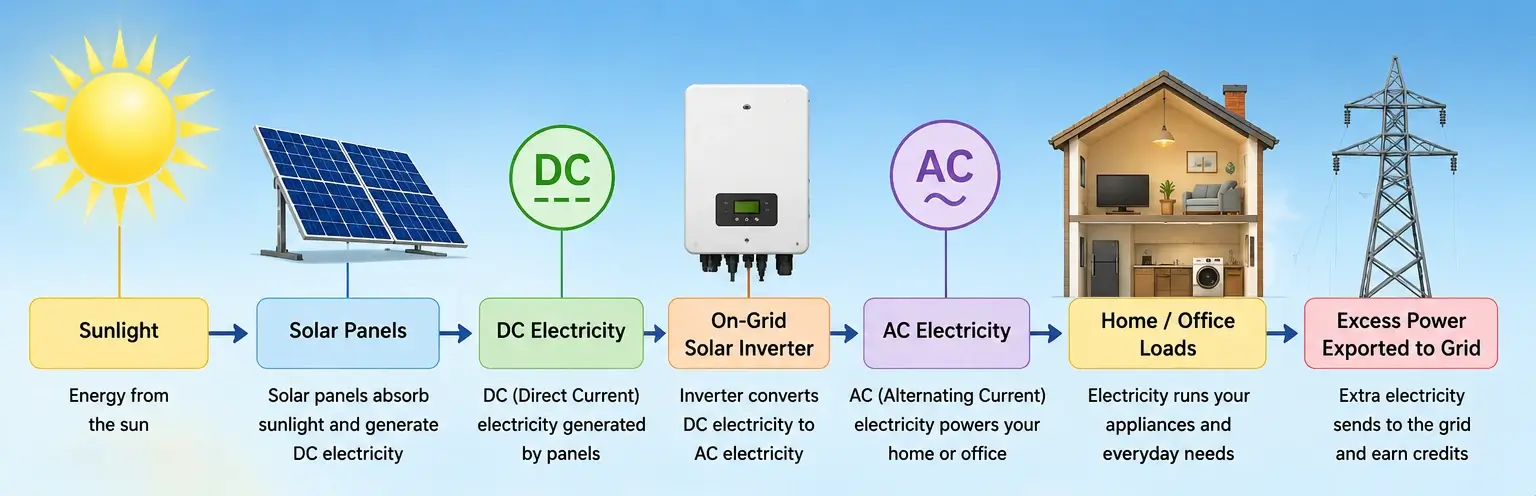
When your solar system generates more electricity than you consume, the excess energy is exported to the electricity grid through net metering.
During nighttime or cloudy weather, electricity is imported back from the grid.
What Is an On-Grid Solar Inverter?
The On-Grid Solar Inverter is the heart of your solar installation.
Its functions include:
- Converts DC to AC electricity
- Synchronizes with the utility grid
- Maximizes solar generation using MPPT
- Monitors system performance
- Provides safety protections
- Supports net metering
A high-quality inverter improves system efficiency and long-term reliability. If you're claiming the government subsidy, your inverter and panels must be listed under MNRE's Approved List of Models and Manufacturers (ALMM) — using a non-ALMM inverter is one of the most common reasons subsidy claims get rejected.
How to Size Your Solar System: A Simple Formula
You don't need an engineer to get a rough estimate. Use this quick method:
- Check your last 3 months of electricity bills and note your average monthly units consumed (kWh).
- Divide by 30 to get your average daily consumption.
- Divide that by roughly 4 (the average peak sun hours in most of India) to estimate the solar system size in kW you need.
Example: If you consume 600 units/month → 20 units/day → 20 ÷ 4 ≈ 5 kW system.
This is a starting estimate only — an installer will refine it based on your roof orientation, shading, and sanctioned load.
Electricity Bill Savings with Solar Power
|
Monthly Electricity Bill |
Recommended Solar System |
Estimated Savings |
|
₹2,000–₹4,000 |
2 kW |
50–70% |
|
₹4,000–₹7,000 |
3 kW |
60–80% |
|
₹7,000–₹12,000 |
5 kW |
70–90% |
|
₹12,000+ |
10 kW+ |
Up to 90% |
Actual savings depend on location, electricity consumption, rooftop space, and local net metering policies. Treat these figures as planning estimates rather than guarantees, and ask any installer you're evaluating for a site-specific generation estimate before you commit.
PM Surya Ghar Muft Bijli Yojana: The Government Subsidy You Shouldn't Miss
If you're installing rooftop solar for your home in 2026, the single biggest factor affecting your payback period is the central government's PM Surya Ghar: Muft Bijli Yojana, launched in February 2024 with a target of one crore (10 million) households.
Subsidy structure (as of 2026):
|
System Size |
Subsidy |
|
Up to 1 kW |
₹30,000 |
|
Up to 2 kW |
₹60,000 |
|
3 kW or above |
₹78,000 (capped) |
The subsidy pays ₹30,000 per kW for the first 2 kW and ₹18,000 for the third kW, capped at ₹78,000, paid directly into the homeowner's bank account via DBT after installation and grid commissioning. Some special-category states, including hill and northeastern states, offer higher top-up slabs on top of the central amount.
Eligibility basics:
- Indian citizen with a residential electricity connection
- Suitable rooftop space
- Should not have previously availed a rooftop solar subsidy on the same property
- Equipment must be ALMM-listed (MNRE-approved)
How to apply: Apply through the official national portal at pmsuryaghar.gov.in. The process typically runs from application to subsidy disbursal in 30–90 days, depending on your state DISCOM's workload.
Housing societies (GHS/RWAs) can also apply for shared rooftop systems, including for common-area EV charging infrastructure, under a separate slab.
Scheme details, subsidy amounts, and eligibility criteria are set by the Ministry of New and Renewable Energy (MNRE) and are subject to periodic revision — always confirm current figures on the official portal before making a financial decision.
Net Metering: Why It Varies by State
Net metering — the mechanism that lets you export surplus solar power to the grid and get credited for it — is implemented differently by each state's electricity regulatory commission. Sanctioned load limits, the ratio of solar capacity to sanctioned load, billing cycles for adjustment of exported units, and paperwork requirements can all differ between, say, Maharashtra, Delhi, and Tamil Nadu.
Before finalizing your system size, check your state DISCOM's or State Electricity Regulatory Commission's (SERC) current net metering regulations, since this affects both your system's maximum permissible size and how quickly exported credits are settled.
Read more: https://seltrik.com/blogs/all-blogs/what-is-solar-net-metering
Solar Power for Businesses
Commercial establishments typically consume much more electricity than homes, making solar a highly attractive investment.
Ideal for:
- Manufacturing units
- Warehouses
- Offices
- Schools
- Hospitals
- Hotels
- Shopping complexes
- Cold storage facilities
Benefits:
- Reduced operating costs
- Faster return on investment (ROI)
- Improved ESG performance
- Greater energy independence
Common Mistakes That Increase Electricity Bills
Avoid these common habits:
- Leaving AC on unnecessarily
- Using old refrigerators
- Ignoring appliance maintenance
- Using incandescent bulbs
- Keeping chargers plugged in
- Running half-load washing cycles
- Poor rooftop insulation
- Delaying solar installation despite high bills
- Installing a non-ALMM-listed inverter and losing subsidy eligibility
How Much Can Solar Save?
A well-designed solar power system can generate electricity for over 25 years. While the upfront investment varies based on system size, location, and available subsidy, many homeowners and businesses recover their investment within 4–5 years through reduced electricity bills, after which generation is essentially free for the remaining system life.
Final Thoughts
Reducing your electricity bill is not just about switching off lights — it requires a combination of energy-efficient practices, smart appliance choices, and long-term investments. While small changes like using LED lights and 5-star appliances help lower consumption, solar power offers the greatest opportunity for lasting savings.
An On-Grid Solar System equipped with a reliable On-Grid Solar Inverter enables homes and businesses to generate clean electricity, reduce dependence on the utility grid, and benefit from net metering. Combined with the PM Surya Ghar Muft Bijli Yojana subsidy, the upfront barrier to going solar is lower than it has ever been.
With rising electricity tariffs and abundant sunshine across India, investing in solar energy is one of the most effective ways to control monthly energy costs and build a more sustainable future.
Frequently Asked Questions (FAQs)
Is solar power worth it in India?
Yes. India receives abundant sunlight throughout the year, making solar one of the most cost-effective long-term investments for reducing electricity bills, especially with the PM Surya Ghar subsidy reducing upfront cost.
What is the difference between an On-Grid Solar System and an Off-Grid Solar System?
An On-Grid Solar System is connected to the utility grid and uses net metering, while an Off-Grid system operates independently using battery storage.
Does an On-Grid Solar Inverter work during a power cut?
No. For safety reasons, most grid-tied inverters automatically shut down during a grid outage (anti-islanding protection) unless paired with backup solutions such as hybrid systems and batteries.
How long do solar panels last?
Most high-quality solar panels have a lifespan of 25 years or more, with gradual performance degradation over time.
Can businesses install solar power?
Absolutely. Commercial and industrial facilities often achieve significant cost savings due to their higher daytime electricity consumption, which aligns well with solar generation.
How much subsidy can I get under PM Surya Ghar?
Up to ₹78,000 for a 3 kW or larger residential system, with the exact amount depending on your system size, as detailed in the subsidy table above. Confirm current rates on the official portal