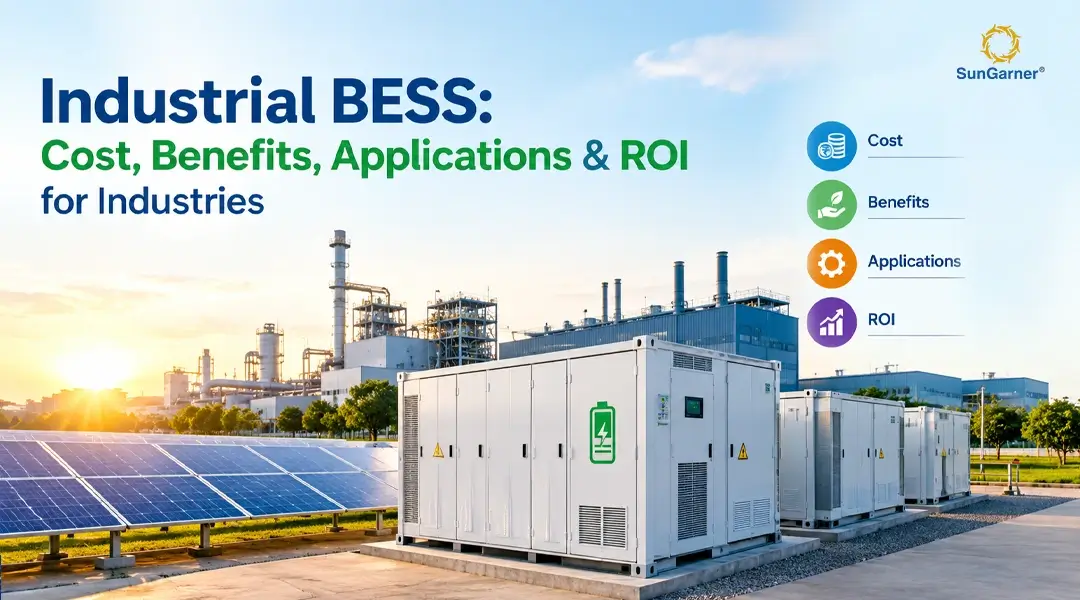
Industrial BESS: Cost, Benefits, Applications & ROI for Industries
Industrial electricity consumption is becoming more complex. Manufacturing plants, warehouses, process industries, data centres, cold-storage facilities and other energy-intensive operations need reliable power while managing rising electricity costs, peak demand charges and increasing renewable-energy requirements.
This is where an Industrial Battery Energy Storage System (BESS) can create significant value.
An industrial BESS can store electricity and dispatch it when the facility needs it most. When integrated with rooftop or ground-mounted solar, it can store excess renewable generation and make that energy available during evening peaks, production hours or grid interruptions.
For industrial consumers, the business case is no longer limited to backup power. A properly designed BESS can combine peak shaving, time-of-day tariff optimisation, solar self-consumption, backup power, demand management and energy-cost optimisation in a single system.
India's energy-storage ecosystem is also expanding rapidly. The Ministry of New and Renewable Energy maintains dedicated policies and guidelines for energy storage, including viability-gap funding initiatives, transmission-charge provisions and guidance on co-locating storage with solar projects.
What Is Industrial BESS?
An Industrial BESS (Battery Energy Storage System) is a large-scale battery-based energy storage solution installed at an industrial facility to store electricity and supply it when required.
Unlike a conventional battery backup system, an industrial BESS combines:
- Battery energy storage
- Battery Management System (BMS)
- Power Conversion System (PCS)
- Energy Management System (EMS)
- Thermal management
- Protection and safety systems
- Monitoring and control systems
The system can charge from the grid, solar PV or another permitted energy source and discharge according to the facility's operating requirements.
For industrial consumers, the objective is usually not simply to store electricity. The objective is to use electricity at the right time and at the lowest practical overall energy cost.
Industrial BESS at a Glance
|
Parameter |
Industrial BESS |
|
Primary purpose |
Energy storage and optimisation |
|
Typical chemistry |
Lithium-ion, particularly LFP |
|
Main applications |
Peak shaving, ToD shifting, solar integration, backup |
|
Power rating |
kW to MW |
|
Energy capacity |
kWh to MWh |
|
Charging sources |
Grid, solar or hybrid |
|
Control system |
EMS + BMS |
|
Response |
Very fast, depending on system design |
|
Installation |
Behind-the-meter, hybrid or grid-connected |
|
Best suited for |
Factories, warehouses, C&I facilities, process industries and critical loads |
Why Are Industries Considering BESS in India?
Industrial facilities often experience a combination of:
- High electricity consumption
- Peak demand charges
- Time-of-day tariff differences
- Solar generation mismatch with demand
- Grid interruptions
- Diesel generator dependency
- Increasing renewable-energy requirements
- Power-quality concerns
- Pressure to reduce Scope 2 emissions
A solar system can reduce electricity purchased from the grid, but it cannot generate power after sunset.
A conventional backup generator can provide power during outages, but it normally does not create financial value when the grid is operating.
A BESS can potentially perform both roles while also participating in daily energy optimisation.
This makes Solar + BESS + Grid + DG a powerful architecture for many industrial facilities.
How Does an Industrial BESS Work?
The basic operating cycle is straightforward:
Step 1: Charge
The BESS stores electricity when energy is available or economically attractive.
Charging may come from:
- Rooftop solar
- Ground-mounted solar
- Grid electricity during lower-cost periods
- Hybrid renewable-energy systems
Step 2: Store
The battery stores electrical energy as DC power.
The BMS continuously monitors parameters such as:
- State of charge (SoC)
- Voltage
- Current
- Temperature
- Cell condition
- Fault conditions
Step 3: Convert
The PCS converts DC electricity from the battery into AC electricity suitable for the facility or grid.
Step 4: Dispatch
The EMS determines when the battery should charge or discharge.
For example:
Low-demand period → Charge
Solar surplus → Charge
Peak tariff period → Discharge
Grid outage → Support critical loads
Peak demand approaching → Discharge to reduce grid demand
The intelligence of the EMS is therefore critical to the financial performance of the project.
Industrial BESS Cost in India
One of the first questions businesses ask is:
How much does an Industrial BESS cost in India?
There is no single BESS price applicable to every industrial project.
The final project cost depends on:
- Battery capacity
- Power rating
- Battery chemistry
- Number of battery racks
- PCS capacity
- EMS requirements
- HVAC/thermal management
- Fire detection and suppression
- Transformer and switchgear requirements
- Civil and electrical work
- Installation location
- Grid interconnection
- Monitoring requirements
- Warranty and O&M scope
As a broad 2026 market benchmark, installed C&I BESS pricing can vary substantially by project scale. Current industry guidance indicates approximately ₹25,000–₹40,000 per kWh for smaller systems and roughly ₹15,000–₹25,000 per kWh for larger multi-MWh systems, before project-specific variations, taxes and interconnection requirements.
These figures should be treated as initial budgeting benchmarks rather than final EPC quotations.
Illustrative Industrial BESS Cost
|
BESS Size |
Indicative Cost Range* |
|
100 kWh |
₹25–40 lakh |
|
250 kWh |
₹62.5 lakh–₹1 crore |
|
500 kWh |
₹1.25–2 crore |
|
1 MWh |
₹2.5–4 crore |
|
2 MWh |
₹3–5 crore+ |
|
5 MWh |
Project-specific |
*Indicative market-level estimates. Actual project pricing depends on battery chemistry, power rating, PCS, EMS, safety systems, civil/electrical infrastructure, installation conditions, taxes and other project requirements.
Important:
Do not select an industrial BESS based only on ₹/kWh.
Two systems with the same 1 MWh capacity can have significantly different prices because their:
- Power ratings
- C-rate
- PCS size
- Warranty
- Cycle life
- EMS functionality
- Fire-safety systems
- Thermal management
- Installation requirements
may be completely different.
What Determines Industrial BESS Cost?
1. Battery Capacity
A 1 MWh system stores twice as much energy as a 500 kWh system, but battery capacity is only one part of the total project cost.
2. Power Rating
A BESS rated at 1 MW/2 MWh and another rated at 500 kW/2 MWh have the same energy capacity but very different discharge capabilities.
For peak shaving, power capacity can be just as important as energy capacity.
3. Battery Chemistry
LFP lithium-ion batteries are widely considered for stationary storage because of their combination of safety characteristics, cycle performance and suitability for frequent cycling.
4. PCS
The Power Conversion System determines how efficiently and at what power level energy can move between the battery and AC electrical system.
5. EMS
The EMS is responsible for deciding:
- When to charge
- When to discharge
- How much energy to reserve
- How to respond to demand peaks
- How to maximise solar utilisation
- How to coordinate multiple energy sources
6. Safety Infrastructure
Industrial BESS projects may require:
- Fire detection
- Fire suppression
- Thermal monitoring
- HVAC
- Emergency shutdown
- Gas detection
- Electrical protection
- Battery isolation
7. Site Infrastructure
Additional costs can arise from:
- Transformers
- HT/LT panels
- Cables
- Civil foundations
- Container installation
- Earthing
- Protection systems
- Communication infrastructure
Industrial BESS vs Conventional Battery Backup
An industrial BESS should not be viewed simply as a larger UPS.
|
Feature |
Conventional Backup Battery |
Industrial BESS |
|
Main objective |
Backup |
Energy optimisation + backup |
|
Peak shaving |
Limited |
Yes |
|
ToD optimisation |
Usually no |
Yes |
|
Solar integration |
Limited |
Yes |
|
EMS |
Basic/limited |
Advanced |
|
Scale |
Usually smaller |
kWh to MWh |
|
Energy arbitrage |
No |
Possible |
|
Demand management |
Limited |
Yes |
|
Critical-load backup |
Yes |
Yes |
|
Multiple value streams |
Limited |
Yes |
A modern C&I BESS combines battery storage with BMS, PCS and EMS to create a controllable energy asset.
Top Benefits of Industrial BESS
1. Peak Demand Reduction
For many industrial consumers, the highest demand recorded during a billing period can materially affect electricity costs.
A BESS can discharge when facility demand approaches a predefined threshold.
Example
Suppose a factory normally operates at 2 MW but occasionally reaches 2.5 MW during production peaks.
A properly sized BESS can discharge during those peaks and reduce the amount of power drawn from the grid.
This is known as peak shaving.
The actual financial benefit depends on the applicable tariff, demand-charge structure and facility load profile.
2. Time-of-Day Tariff Optimisation
Electricity prices can vary depending on the time of consumption.
A BESS can:
Charge → lower-cost period
Store → battery
Discharge → higher-cost period
This process is commonly known as time-of-day arbitrage.
The greater the difference between charging and discharging electricity costs, the stronger the potential value of this application.
However, actual savings depend on the state's tariff structure, applicable consumer category, battery efficiency and number of useful cycles.
3. Maximise Solar Self-Consumption
Solar generation and industrial demand do not always occur at the same time.
For example:
Afternoon
Solar generation → High
Factory demand → Moderate
Evening
Solar generation → Zero
Factory demand → High
Without storage, excess solar may be exported or curtailed depending on the project's configuration and applicable regulations.
With BESS:
Solar surplus → Battery → Evening industrial load
This can increase the amount of renewable electricity consumed by the facility itself.
4. Reduce Diesel Generator Dependency
Many industrial facilities maintain diesel generators for backup.
A BESS can provide fast backup support for suitable critical loads and can also work in a hybrid configuration with a DG.
Hybrid architecture
Grid + Solar + BESS + DG → EMS → Industrial Load
The BESS can respond immediately to an outage while the generator can be used for longer-duration requirements where necessary.
This approach can potentially reduce:
- Diesel consumption
- Generator operating hours
- Maintenance requirements
- Noise
- Local emissions
The appropriate configuration depends on the facility's critical-load requirement and outage profile.
5. Improve Energy Reliability
Certain industries cannot afford even short interruptions.
Examples include:
- Data centres
- Pharmaceutical manufacturing
- Food processing
- Cold storage
- Semiconductor and electronics manufacturing
- Continuous-process industries
A BESS can provide fast-response power support for appropriately designed critical loads.
6. Support Power Quality
Depending on the PCS and system architecture, energy storage can also support aspects of electrical performance such as:
- Voltage support
- Frequency response
- Load balancing
- Power smoothing
The exact capability depends on the equipment and grid connection.
7. Reduce Renewable Energy Curtailment
As renewable generation increases, storing surplus electricity becomes increasingly important.
India is expanding energy storage as part of its broader renewable-energy strategy. The government has introduced multiple BESS-related policy measures, including VGF mechanisms and other frameworks intended to accelerate storage deployment.
Industrial BESS Applications
1. Manufacturing Plants
Factories can use BESS for:
- Peak shaving
- Solar integration
- Demand management
- Backup
- Energy-cost optimisation
Typical industries include:
- Automotive
- Auto components
- Engineering
- Electronics
- Machinery
- Chemical manufacturing
- Consumer goods
2. Textile Industry
Textile plants often operate energy-intensive machinery for long periods.
BESS can help manage:
- Peak demand
- Solar utilisation
- Shift-based consumption
- Backup requirements
3. Food Processing
Food processing facilities may have significant refrigeration and process loads.
BESS can support energy management while helping protect critical operations from short-duration interruptions.
4. Cold Storage and Warehouses
Cold-storage facilities have substantial refrigeration loads that can continue beyond solar-generation hours.
Solar + BESS can help shift renewable energy into evening and night-time consumption.
5. Pharmaceutical Manufacturing
Pharmaceutical facilities often require reliable electricity for:
- HVAC
- Clean rooms
- Refrigeration
- Production systems
- Monitoring equipment
BESS can be designed to support selected critical loads during grid disturbances.
6. Data Centres
Data centres require highly reliable power and increasingly face significant electricity consumption.
BESS can complement existing UPS and backup-generation infrastructure by providing:
- Fast-response power
- Peak-demand management
- Renewable integration
- Energy optimisation
7. Steel, Metal and Heavy Industries
High-power industrial equipment can create significant demand spikes.
A BESS can potentially reduce these peaks when the system is correctly sized around the facility's interval demand profile.
Industrial Solar + BESS: Why the Combination Is Powerful
Solar and BESS solve different energy problems.
Solar answers:
“How can we generate more of our electricity from renewable energy?”
BESS answers:
“When should we use that electricity?”
Combining both creates a more flexible energy system.
Typical architecture
Solar PV → DC/AC System → Industrial Load
with:
Solar PV → BESS → Industrial Load
and:
Grid → BESS → Industrial Load
An EMS coordinates the system.
How Much BESS Does an Industry Need?
There is no universal BESS size for a factory.
The correct system must be based on actual operational data.
Two parameters are especially important:
Power — kW / MW
How much power must the BESS deliver at a particular moment?
Energy — kWh / MWh
How long must the BESS deliver that power?
Basic relationship
Energy Capacity = Power × Duration
For example:
A:
1 MW / 2 MWh BESS
can theoretically deliver:
1 MW for approximately 2 hours
under the relevant operating assumptions.
Actual usable energy depends on battery operating limits, efficiency, reserve requirements and system design.
How to Size an Industrial BESS
Step 1: Collect Electricity Bills
Review at least 12 months of:
- Electricity bills
- Maximum demand
- Energy consumption
- Tariff
- Power factor
- Time-of-day consumption
Step 2: Analyse 15-Minute Load Data
Interval data is critical.
It helps identify:
- Daily peaks
- Peak duration
- Seasonal changes
- Average load
- Maximum demand
- Load variability
Step 3: Define the Primary Objective
Ask:
What is the main reason for installing BESS?
Is it:
- Peak shaving?
- Solar self-consumption?
- ToD arbitrage?
- Backup?
- Diesel reduction?
- Multiple applications?
Step 4: Determine Power Requirement
For peak shaving, calculate how much demand needs to be reduced.
Step 5: Determine Energy Requirement
Calculate how long the BESS needs to operate during the target period.
Step 6: Model Multiple Scenarios
Compare:
BESS only
vs.
Solar + BESS
vs.
Solar + BESS + DG
The best configuration is the one that produces the strongest technical and financial outcome—not necessarily the system with the largest battery.
Industrial BESS ROI: How Is It Calculated?
Industrial BESS ROI should be calculated from actual operating data rather than a generic payback number.
A simplified calculation is:
Annual BESS Savings = Demand Charge Savings + ToD Savings + Solar Savings + DG Savings + Other Applicable Benefits
Then:
Simple Payback = Total Project Cost ÷ Annual Savings
Example
Suppose an industrial facility invests:
BESS project cost = ₹3 crore
and the project generates:
Annual measurable savings = ₹60 lakh
Then:
Simple Payback = ₹3 crore ÷ ₹60 lakh
= 5 years
This is only an illustration.
Actual project economics should account for:
- Battery degradation
- Round-trip efficiency
- Financing cost
- O&M
- Tariff escalation
- Replacement assumptions
- Warranty
- Residual value
- Number of cycles
- System availability
What Determines BESS ROI?
High-value BESS projects generally have one or more of these characteristics:
High Demand Charges
The facility regularly reaches high monthly demand.
Significant ToD Difference
There is a meaningful difference between low-cost and high-cost electricity periods.
Existing Solar
There is excess solar generation that can be stored rather than exported.
High Diesel Consumption
The facility frequently operates DGs.
Critical Loads
Power interruptions have a significant financial impact.
High Energy Consumption
Large electricity consumption creates more opportunities for optimisation.
Typical Industrial BESS Payback Period
There is no single payback period that applies to every industrial facility.
Current C&I market guidance commonly places well-designed multi-use BESS projects in approximately the 4–5 year payback range, while single-use peak-shaving projects can have longer payback periods.
The strongest economics generally come from stacking multiple value streams rather than using the battery for only one purpose.
For example:
Peak Shaving + ToD Optimisation + Solar Self-Consumption + Backup
can potentially create a stronger business case than:
Peak Shaving Only
Industrial BESS Operating Cost
A BESS does not require fuel like a diesel generator, but it still has operating costs.
Typical considerations include:
- Preventive maintenance
- Remote monitoring
- HVAC/auxiliary consumption
- Software/EMS support
- Insurance
- Spare parts
- Battery degradation
- Periodic inspections
The financial model should therefore evaluate lifetime cost, not only initial CAPEX.
Battery Degradation: An Important ROI Factor
Battery capacity gradually declines over its operating life.
The rate depends on:
- Chemistry
- Depth of discharge
- Temperature
- Charge/discharge rate
- Number of cycles
- Operating strategy
- State-of-charge window
Therefore, an industrial BESS financial model should include degradation rather than assuming the battery will deliver its initial rated capacity indefinitely.
Why LFP Is Commonly Considered for Industrial BESS
Lithium Iron Phosphate (LFP) is widely used in stationary storage applications because it offers a combination of:
- Good cycle performance
- High thermal stability compared with some other lithium chemistries
- Suitable energy density
- Long operating life when properly managed
- Established stationary-storage ecosystem
The battery chemistry should nevertheless be selected according to the project's safety, performance, temperature, space, cycle and commercial requirements.
Major Components of an Industrial BESS
1. Battery Pack
Stores electrical energy.
2. Battery Management System
Monitors and protects individual cells and battery modules.
3. PCS
Converts between AC and DC electricity.
4. EMS
Controls charging, discharging and energy optimisation.
5. HVAC / Thermal Management
Maintains the battery system within its required operating conditions.
6. Fire Detection and Suppression
Provides protection against thermal events and other fire risks.
7. Transformer
Steps voltage up or down according to project requirements.
8. Switchgear and Protection
Provides isolation, switching and electrical protection.
9. SCADA / Monitoring
Provides system visibility, alarms, data and performance monitoring.
Industrial BESS Safety
Safety should be one of the first considerations—not an afterthought.
A properly engineered BESS project should evaluate:
- Battery chemistry
- Cell quality
- Thermal management
- Battery enclosure
- Fire detection
- Fire suppression
- Electrical isolation
- Emergency shutdown
- Ventilation
- Fault monitoring
- Site access
- Emergency response procedures
The project should also comply with applicable electrical, fire-safety, environmental and local regulatory requirements.
Industrial BESS vs Diesel Generator
|
Parameter |
Industrial BESS |
Diesel Generator |
|
Fuel required |
No |
Yes |
|
Local emissions during operation |
None from battery discharge |
Yes |
|
Response time |
Very fast |
Slower |
|
Peak shaving |
Yes |
No |
|
ToD optimisation |
Yes |
No |
|
Solar integration |
Excellent |
Limited |
|
Normal-operation financial value |
Yes |
Generally no |
|
Long-duration backup |
Project-dependent |
Strong |
|
Noise |
Low |
High |
|
Maintenance |
Periodic |
Higher mechanical maintenance |
For long-duration outages, a BESS + DG hybrid system may be more appropriate than replacing the generator entirely.
Industrial BESS vs Solar Without Storage
|
Requirement |
Solar Only |
Solar + BESS |
|
Reduce daytime grid consumption |
Yes |
Yes |
|
Store excess solar |
No |
Yes |
|
Evening solar utilisation |
Limited |
Yes |
|
Peak shaving |
Limited |
Yes |
|
ToD optimisation |
No |
Yes |
|
Backup capability |
Limited |
Yes |
|
Energy dispatch control |
Limited |
High |
|
Solar self-consumption |
Good |
Potentially higher |
For an industrial facility operating heavily outside solar hours, adding storage can significantly improve the usefulness of renewable generation.
What Should Businesses Check Before Buying an Industrial BESS?
Do not compare BESS suppliers only on battery price.
Evaluate:
Technical
- Battery chemistry
- Cell manufacturer
- Usable capacity
- Rated power
- Round-trip efficiency
- Cycle life
- Operating temperature
- IP rating
- C-rate
Safety
- BMS architecture
- Thermal monitoring
- Fire detection
- Fire suppression
- Emergency shutdown
- Safety certifications
- Installation standards
Commercial
- Warranty
- Performance guarantee
- Battery degradation guarantee
- O&M terms
- Availability guarantee
- Response time
- Spare-parts support
- Software/EMS support
Project
- EPC scope
- Civil work
- Electrical work
- Transformer
- PCS
- EMS
- Grid integration
- Commissioning
- Monitoring
Industrial BESS for Solar-First Factories
For factories with substantial rooftop or ground-mounted solar, a Solar + BESS configuration can be particularly attractive.
A typical operating strategy could be:
Morning
Solar supplies factory load.
Midday
Solar generation exceeds demand.
Excess solar → BESS charging
Evening
Solar production decreases.
BESS → Factory load
Peak period
BESS discharges strategically to reduce grid demand.
Grid outage
BESS supports designated critical loads.
This transforms the BESS from a backup asset into an active energy-management asset.
Industrial BESS and India's Energy Transition
India's energy-storage market is moving from demonstration projects toward larger commercial and industrial deployments.
The Ministry of New and Renewable Energy lists multiple BESS-related measures, including VGF schemes, transmission-charge provisions and policies supporting storage integration.
The broader market is also seeing substantial investment in domestic battery-storage manufacturing and BESS deployment. Recent industry developments include new large-scale manufacturing capacity aimed at serving commercial, industrial and utility applications.
At the same time, battery-storage project economics remain sensitive to battery and commodity prices, financing and project design, meaning industrial buyers should evaluate projects on their own load and tariff data rather than relying on a single national cost benchmark.
The Future of Industrial Energy Management
The future industrial power system is increasingly moving toward:
Solar + Grid + BESS + DG + EMS
rather than depending on a single electricity source.
The EMS becomes the central intelligence layer.
It can determine:
- When solar should power the factory
- When excess solar should charge the battery
- When the battery should discharge
- When grid power should be used
- When demand should be reduced
- When backup resources should start
This creates a more flexible and controllable energy system.
Is Industrial BESS Worth the Investment?
For the right industrial facility, yes—but the answer should come from a project-specific energy analysis.
BESS economics are generally more attractive when a facility has:
- High electricity consumption
- High demand charges
- Significant peak/off-peak tariff differences
- Existing solar
- High evening demand
- Frequent short-duration outages
- Significant DG usage
- Critical electrical loads
- A strong need for renewable-energy integration
On the other hand, a facility with a flat tariff, low demand charges and minimal operational variability may have a weaker BESS business case.
The best approach is therefore:
Load Data → Energy Audit → BESS Simulation → Financial Model → System Design → Implementation
Final Takeaway
Industrial BESS is evolving from a backup-power technology into a broader energy-management solution.
For factories and other energy-intensive businesses, the biggest opportunity may not come from using the battery for a single purpose. The strongest business cases can come from combining:
Peak Shaving + ToD Optimisation + Solar Self-Consumption + Backup + Energy Management
The right BESS therefore starts with the load profile, not the battery catalogue.
A detailed analysis of electricity bills, interval demand, tariff structure, solar generation and operational requirements can determine whether an industrial BESS makes financial sense—and what size and configuration will deliver the best long-term value.
For industrial businesses evaluating BESS, Solar + BESS, peak-demand management or large-scale solar integration, SunGarner Energies provides an integrated approach covering system design, engineering, installation, commissioning and energy-storage solutions.
Frequently Asked Questions
What is Industrial BESS?
Industrial BESS is a battery energy storage system designed for industrial facilities to store electricity and use it strategically for peak shaving, solar integration, time-of-day optimisation, backup and energy management.
How much does an Industrial BESS cost in India?
Indicative 2026 C&I BESS costs can range from approximately ₹25,000–₹40,000/kWh for smaller systems to around ₹15,000–₹25,000/kWh for larger systems, depending on system size and configuration. Actual project cost must be determined through a detailed technical and commercial assessment.
What is the ROI of Industrial BESS?
ROI depends on the facility's tariff, load profile, demand charges, battery utilisation, solar generation and number of value streams. Well-designed multi-use C&I projects can potentially achieve payback in roughly 4–7 years, but individual projects can be significantly different.
Can BESS work without solar?
Yes. An industrial BESS can charge from the grid and discharge during periods when electricity is more expensive or when demand needs to be controlled.
Can BESS replace a diesel generator?
Not always. BESS can replace or reduce DG operation for suitable backup requirements, particularly short-duration outages. For long-duration backup, a hybrid BESS + DG system may be more appropriate.
How is Industrial BESS sized?
BESS sizing is based mainly on required power in kW/MW, required energy in kWh/MWh, operating duration, load profile and the intended application.
What battery chemistry is suitable for Industrial BESS?
LFP lithium-ion is widely considered for stationary BESS applications, but the appropriate chemistry depends on safety, cycle requirements, operating conditions, space and project economics.
Can BESS reduce peak demand charges?
Yes. A properly sized and controlled BESS can discharge during demand peaks and reduce the maximum grid demand recorded by the facility, subject to the applicable tariff structure.
Can BESS store excess solar power?
Yes. Solar energy that is not immediately consumed can be directed to the BESS and later discharged when required, subject to system configuration and applicable electrical/regulatory requirements.
What is the difference between MW and MWh in BESS?
MW represents the power the BESS can deliver at a given moment.
MWh represents the amount of energy the battery can store.
For example, a 1 MW / 2 MWh BESS can theoretically deliver 1 MW for approximately two hours under suitable operating conditions.