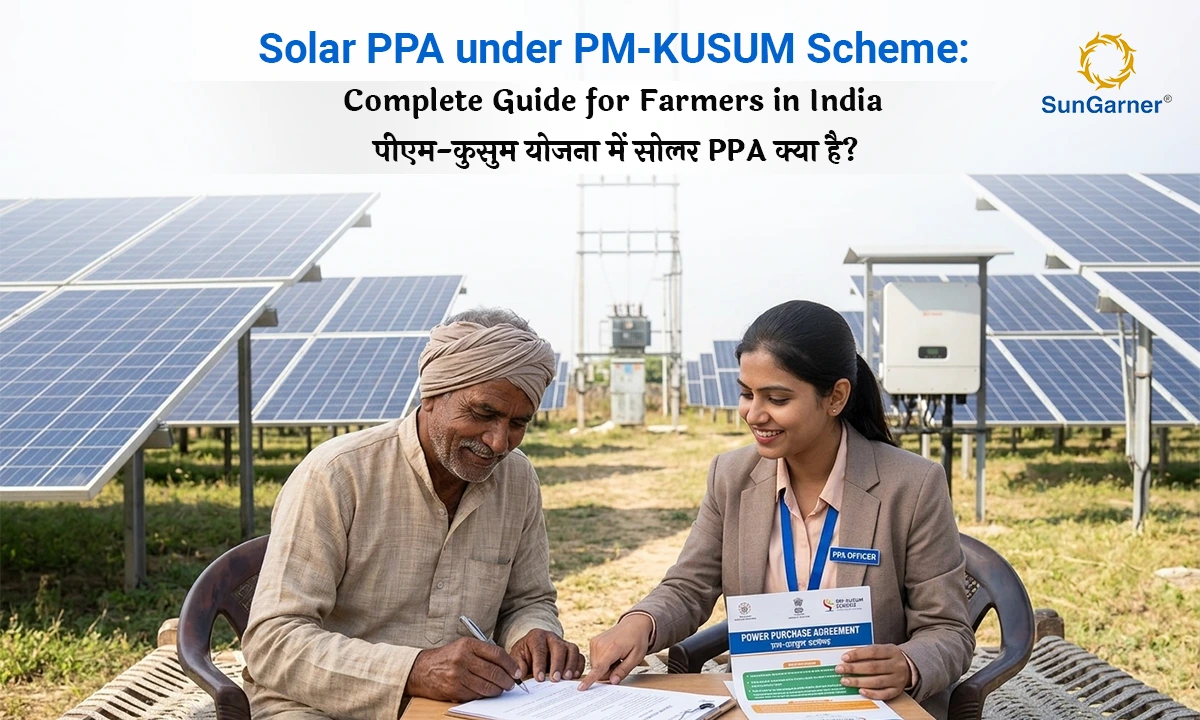
Solar PPA under PM-KUSUM Scheme: Complete Guide for Farmers in India
India is rapidly expanding its renewable energy sector, and solar energy is playing a crucial role in this transformation. To empower farmers and increase decentralized solar power generation, the Government of India launched the PM-KUSUM Yojana.
India is rapidly expanding its renewable energy sector, and solar energy is playing a crucial role in this transformation. To empower farmers and increase decentralized solar power generation, the Government of India launched the PM-KUSUM Yojana.
Under this scheme, farmers can install solar power plants on their land and sell the generated electricity to electricity distribution companies through a Power Purchase Agreement (PPA).
This guide explains everything farmers and developers need to know about Solar PPA under the PM-KUSUM scheme.
What is a Solar Power Purchase Agreement (PPA)?
A Power Purchase Agreement (PPA) is a legal contract between a solar power producer and an electricity distribution company.
In India, electricity distribution companies are commonly known as DISCOM.
Under a PPA:
- The solar plant owner generates electricity.
- The DISCOM purchases the electricity at a predetermined tariff.
- The agreement typically lasts 20–25 years.
This long-term contract ensures financial stability and predictable revenue for farmers or solar project developers.
How the PM-KUSUM Scheme Helps Farmers Earn from Solar Energy
The PM-KUSUM scheme was launched by the Ministry of New and Renewable Energy to support farmers and reduce dependence on diesel pumps.
The scheme allows farmers to:
- Install solar power plants on their land
- Generate clean electricity
- Sell electricity to DISCOMs
- Earn long-term stable income
Many farmers are now converting unused or low-productivity land into solar power generation assets.
Benefits of Solar PPA for Farmers
Solar PPA offers multiple benefits for farmers and rural landowners.
1 Long-Term Guaranteed Income
Farmers receive regular payments for electricity sold to DISCOMs.
2 No Need to Sell Land
Farmers retain ownership of their land while earning revenue.
3 Stable Tariff for Electricity
Electricity tariffs are fixed under the agreement, protecting farmers from market fluctuations.
4 Additional Rural Income Source
Solar power projects provide a second income stream alongside agriculture.
5 Support for Clean Energy Goals
Solar projects help India achieve its renewable energy targets.
How Much Solar Capacity Can a Farmer Install?
The solar plant capacity depends on several factors:
- Size of the land
- Distance from the nearest grid substation
- Grid connectivity availability
- State solar policy regulations
Authorities assess these parameters before approving solar project capacity.
Documents Required for Solar PPA Application
Farmers must submit several documents during the application process.
Commonly required documents include:
- Land ownership proof
- Identity proof
- Bank account details
- Project proposal
- Grid connectivity details
In some cases, developers may need to submit a Performance Bank Guarantee (PBG).
Step-by-Step Process to Apply for Solar PPA
The application process generally follows these steps:
Step 1: Farmer Registration
Register on the official portal.
Step 2: Submit Application Form
Fill out the solar project application.
Step 3: Upload Required Documents
Submit land and identity documents.
Step 4: Technical Evaluation
Authorities check grid connectivity and feasibility.
Step 5: Approval and PPA Signing
After approval, the farmer signs a PPA with the DISCOM.
Step 6: Solar Plant Installation
The solar project is installed and connected to the grid.
Where to Apply for PM-KUSUM Solar PPA
Farmers can apply through the official portal of the Ministry of New and Renewable Energy.
Official portal:
From the portal, farmers can select their state and begin the application process.
State-Level Solar Portals for PPA Application
Applications are often processed through state renewable energy agencies.
For example, in Uttar Pradesh, farmers apply through the Uttar Pradesh New and Renewable Energy Development Agency portal.
Portal:
https://upnedakusumc1.in/
The process usually includes registration, login, application submission, and document upload.
Challenges Farmers May Face in Solar PPA Projects
While solar projects offer many benefits, farmers may encounter certain challenges.
These include:
- Grid connectivity limitations
- High initial project costs
- Approval delays
- Land documentation issues
However, government policies and financial support programs are continuously improving the process.
Future of Solar PPA Projects in India
India aims to achieve massive renewable energy capacity in the coming years. Solar power projects under schemes like PM-KUSUM will play a major role.
Solar PPA projects are expected to:
- Increase farmer income
- Expand rural renewable energy infrastructure
- Reduce carbon emissions
- Support India's clean energy transition
Conclusion
Solar PPA under the PM-KUSUM scheme offers a powerful opportunity for farmers to generate long-term income while supporting India's renewable energy growth.
By installing solar power plants and selling electricity to DISCOMs, farmers can transform their land into a sustainable energy asset.
Watch Video Guide for Better Understanding
If you want a visual explanation of how Solar PPA works under the PM-KUSUM scheme, watch the video below:
https://www.youtube.com/watch?v=Uu7I7D5DhrM
Frequently Asked Questions (FAQs)
Q: What is the duration of a Solar PPA?
A: Solar PPAs typically last 20–25 years.
Q: Can farmers install solar plants on agricultural land?
A: Yes, farmers can install solar plants on their own land under the PM-KUSUM scheme.
Q: Who buys electricity under the PPA?
A: Electricity distribution companies (DISCOMs) purchase the electricity.
Q: Can developers apply instead of farmers?
A: Yes, developers can also participate in solar PPA projects depending on the state policy.